
By Romy J. Malu
The Limits of U.S. Counterterrorism Efforts in the Horn of Africa
Why military force alone has not produced lasting stability in a campaign that continues largely out of public view.
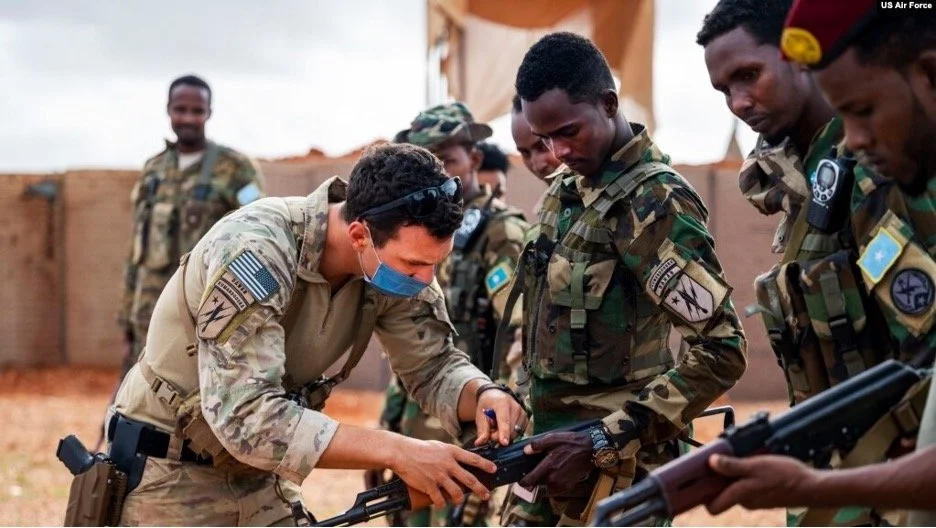
U.S. forces host a range day with the Danab Brigade in Somalia. May 9, 2021. (U.S. Air Force)
Editorial Note: This article was originally drafted in 2023 while the author was deployed in the Horn of Africa on a security mission under U.S. Africa Command (AFRICOM). The analysis reflects conditions and observations from that period and is intended to contribute to ongoing discussion of U.S. counterterrorism policy in the region.
Public attention in the United States has shifted toward domestic social turmoil and great-power competition following the withdrawal of U.S. troops from Afghanistan and the wind-down of large-scale ground combat operations in Iraq, yet American forces remain engaged in a counterterrorism campaign in the Horn of Africa against armed groups that remain operational and capable of controlling or contesting territory in multiple areas and exerting authority over civilians even after decades of U.S. military intervention. The persistence of these armed groups raises a question that has followed U.S. counterterrorism policy for more than two decades: can military force alone resolve a crisis rooted in political fragility and social breakdown, or does it merely contain its symptoms.
In the early morning hours of January 5, 2020, the al-Qaeda–linked group Al-Shabaab carried out a coordinated attack at Manda Bay, Kenya, targeting U.S. military personnel and facilities associated with Camp Simba. The assault began with indirect fire and was followed by a ground breach as attackers moved across the installation and engaged multiple areas. During the course of the attack, U.S. Army Specialist Henry J. Mayfield Jr. and two U.S. civilian contractors, Dustin Harrison and Bruce Triplett, lost their lives. The incident underscored both the reach of Al-Shabaab and the reality that U.S. forces in the region continue to face a determined adversary despite years of counterterrorism efforts.
The attack at Manda Bay was not an isolated event, but part of a wider regional trend across the Horn of Africa, where armed groups have remained active even after years of U.S. airstrikes and raids that have eliminated senior leaders. Al-Shabaab, for instance, has replaced killed commanders, adjusted its methods of attack, and continued to move fighters and weapons between Somalia and neighboring states even under sustained U.S. military pressure. The group’s endurance illustrates the limits of a counterterrorism strategy that prioritizes kinetic action over building functional governing institutions and economic systems. Military operations can degrade networks and disrupt plots, but they do not change the political and social conditions that allow organizations such as Al-Shabaab to thrive.
In many parts of the Horn of Africa, governing institutions struggle to perform core functions in a consistent and credible manner. As a result, courts are often inaccessible or compromised by corruption, leaving local disputes unresolved for months or even years, and police forces in some areas lack reliable pay, training, and equipment, which weakens public trust and pushes communities to seek alternative sources of protection and order. Furthermore, local administrators are frequently selected through patronage or clan affiliation rather than competence, a practice that further erodes confidence in state authority and contributes to weak or nonexistent infrastructure that limits access to markets, education, and healthcare. Armed groups exploit these failures by offering cash payments, food, or a sense of belonging to recruits. Governments that cannot provide livelihoods or credible governance leave a vacuum that armed groups are quick to fill.
Airstrikes and raids remain the primary response of U.S. forces against armed groups that operate within this vacuum; these actions can disrupt planned attacks and remove individual fighters, but they do not alter the conditions that produce new recruits, which is why violence may decline for a period but tends to return as the underlying political and economic environment remains largely unchanged. This emphasis on the use of military force to combat armed groups in the Horn of Africa resembles elements of U.S. counterinsurgency strategy in Afghanistan, where military operations took precedence while building governing institutions lagged behind. As a result, the Afghan government never developed institutions capable of providing security or commanding public trust without U.S. military backing. And when U.S. forces withdrew, the Taliban rapidly retook control of the country. There is little reason to expect a different outcome in the Horn of Africa if military force continues to substitute for institutional development.
Security cooperation nevertheless remains necessary in the Horn of Africa because partner forces face immediate and often lethal threats, and coordinated military action can prevent attacks and save lives. In Somalia, for example, joint operations between Somali and U.S. forces have disrupted planned assaults, pushed armed groups out of key towns, and reopened roads and markets that had been previously closed or inaccessible. For communities that have lived under constant threat of violence, this shift matters because it allows movement, trade, and daily life to resume with less fear. Despite this, U.S. counterterrorism operations become problematic when they turn into the primary instrument of intervention rather than one element within broader stability efforts. Counterterrorism operations may suppress violence in the short term but do not resolve the governance failures and economic deprivation that allow armed groups to recruit and expand.
If lasting stability is the objective rather than indefinite containment of insecurity, U.S. counterterrorism policy in the Horn of Africa must give greater weight to building institutions that shape political authority, because durable order depends on courts that resolve disputes fairly, local authorities that operate transparently, schools that provide quality education to young people, and efforts that eradicate corruption. Lawful avenues for earning a living matter just as much, since the absence of work and opportunity narrows choices and leaves space for armed groups to present themselves as a source of income or protection. These measures do not produce dramatic headlines, but they determine whether military gains endure beyond the immediate aftermath of counterterrorism operations.
The choice confronting U.S. counterterrorism policy in the Horn of Africa is therefore between maintaining a campaign centered on recurring military operations and treating counterterrorism as inseparable from institutional and economic development. The latter course is slower and less visible, but it provides the only credible prospect of moving beyond a crisis that military force alone has contained without resolving for more than two decades.
Author Bio: Romy J. Malu is a non-commissioned officer in the Army National Guard and the Founder and President of Babel Institute.
Disclaimer: The views expressed are solely those of the author and do not reflect the official position of the U.S. government, the Department of Defense, or the Army National Guard.