
Latin America | Costa Rica
Article By John Trabulsi
March 31, 2026 2:15 pm EDT | Updated July 9, 2026
Costa Rica Agrees to Receive Up to 25 US Deportees Per Week
Costa Rica’s new agreement with the United States expands the Trump administration’s use of third-country deportations, a policy that has already sent migrants and asylum seekers to countries where they have no citizenship or family ties.
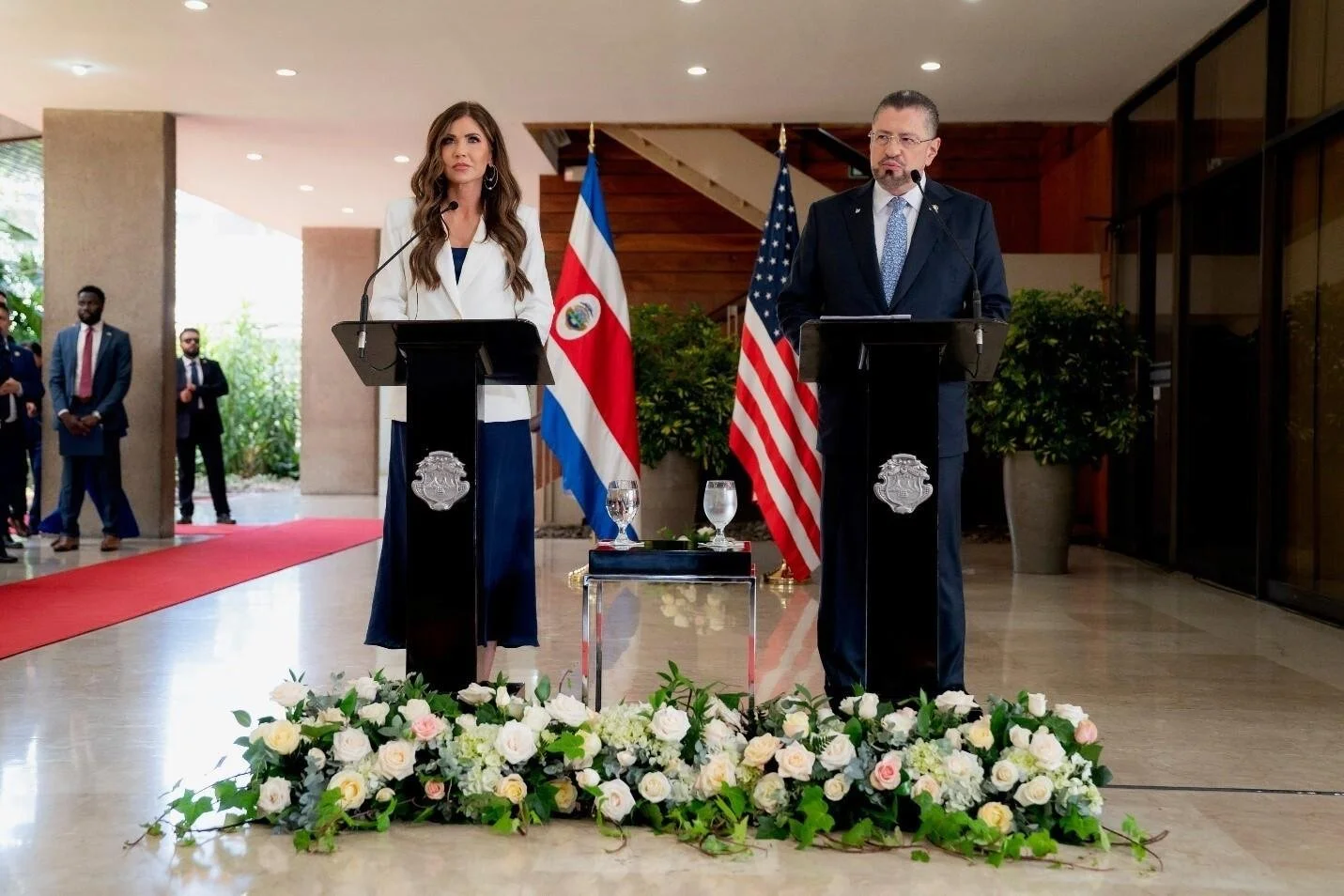
Former US Homeland Security Secretary Kristi Noem and then-Costa Rican President Rodrigo Chaves speak during a joint press conference in San José, Costa Rica, on June 25, 2025. Photo: Tia Dufour/US DHS.
On March 23, Costa Rica signed a memorandum of understanding with the United States to receive up to 25 third-country deportees per week, adding the Central American country to the Trump administration’s expanding use of deportation agreements with foreign governments. The first group of 25 deportees arrived in Costa Rica on April 11 under the new agreement; they were nationals of Albania, Cameroon, China, Guatemala, Honduras, India, Kenya, and Morocco. Costa Rican officials said the United States would provide financial support, while the International Organization for Migration would provide food and housing during the migrants’ first seven days in the country.
Kristi Noem, the former US secretary of homeland security who signed the agreement with then-Costa Rican President Rodrigo Chaves, defended the partnership during her March 23 visit to Costa Rica.
“We are very proud to have partners like President Chaves and Costa Rica, who are working to ensure that people who are in our country illegally have the opportunity to return to their countries of origin,” Noem said.
The deportees will be processed under Costa Rica’s migration law and may seek asylum, request assisted voluntary return, or apply for temporary status to remain in the country.
What Third-Country Deportations Mean
Third-country deportations allow the United States to remove migrants to a country that has agreed to receive them, even when that country is not their country of origin or nationality.
On March 11, the Migration Policy Institute reported that the Trump administration had signed deportation agreements with 27 countries and planned outreach to at least 54 others. The institute said the agreements differ from the administration’s first-term safe-third-country arrangements with Guatemala, Honduras, and El Salvador because the current agreements are tied more directly to deportations from inside the United States, rather than primarily to asylum processing at the US-Mexico border.
Latin American countries reported to be receiving migrants under the Trump administration’s third-country arrangements include Costa Rica, El Salvador, Mexico, and Panama.
In a June 19 explainer, Amnesty International said about 15,000 people were removed from the United States to third countries between January and December 2025, citing Migration Policy Institute estimates. About 13,000 of those removals went to Mexico, according to the same estimate.
Costa Rica Had Accepted U.S. Deportees Before the New MOU
More than a year before Costa Rica signed the new MOU with the United States, the US sent 200 third-country nationals to Costa Rica on two flights in late February 2025. After landing at Juan Santamaría International Airport, they were transported by bus to the Temporary Migrant Reception Center in Corredores, near the country’s border with Panama, according to Human Rights Watch. Those transferred included 81 children between the ages of 1 and 17, two pregnant women, and several adults over the age of 60.
Many of the people expelled to Costa Rica in 2025 had spent months in Mexico waiting for asylum appointments through CBP One, the US government appointment app that the Trump administration ended in January 2025. Human Rights Watch said several of the expelled migrants had sought protection in the United States before being sent to Costa Rica.
Human Rights Watch said that after arriving in Costa Rica, some migrants were held at a migration reception center in Puntarenas and had their passports confiscated by Costa Rican authorities. Several people interviewed by the organization said they had not been given a meaningful opportunity to seek asylum in the United States before they were expelled.
By May 2025, 110 of the 200 people sent to Costa Rica had left through the International Organization for Migration’s Assisted Voluntary Return program, while 34 had applied for asylum and others had left the center independently. Many of those who left independently did so to try to reunite with relatives from whom they had been separated, according to Costa Rica’s Ombudsman’s Office, the country’s national human rights oversight institution.
The 200 people were nationals of Afghanistan, Armenia, Azerbaijan, China, Iran, Russia, Türkiye, Uzbekistan, Vietnam, and Yemen.
Legal Concerns Over Deportees Sent to Costa Rica
According to The Guardian, under the new MOU, the US government must provide information about each person it intends to send to Costa Rica 48 hours before a deportation flight, while Costa Rican authorities retain discretion over the number and nationalities of deportees they accept.
Costa Rican Public Security Minister Mario Zamora Cordero said the agreement would be handled under the country's migration law and that Costa Rica would not send deportees to countries where they could face persecution.
In an April 14 statement, Refugees International said some people sent to Costa Rica may be asylum seekers who were not given a fair chance to present their cases in the United States, or people whom US immigration judges had already ruled should not be returned to their home countries.
Refugees International also warned that deportees could face persecution or torture if they are later pressured to return to their countries of origin through the Assisted Voluntary Return program. The organization also said that deportees in Costa Rica can apply for asylum or temporary status, but the country lacks the institutional capacity to provide meaningful information about those options or conduct asylum interviews in languages other than Spanish.
In June 2025, Costa Rica’s Constitutional Chamber partially upheld a habeas corpus petition filed on behalf of the 200 migrants sent to Costa Rica that February, finding that their right to personal liberty had been violated and ordering their release. The court also instructed the government to determine what health care, education, housing, and other social assistance they required and ordered compensation for the harm caused by their detention.
Children and Families Sent to Costa Rica
In February 2025, 81 of the 200 people the United States sent to Costa Rica were children between the ages of 1 and 17. The group also included families, some of whom were separated during the deportation process.
Of the 200 people sent to Costa Rica, 81 were children between the ages of 1 and 17. Families were also among those deported, and some were separated during the process. Human Rights Watch reported one case involving an extended Afghan family whose relatives were split across three countries: one woman was sent to Panama, her husband and 19-year-old brother remained in the United States, and her sister, brother-in-law, and 14-month-old nephew were sent to Costa Rica.
The new MOU does not exclude children from being deported to Costa Rica and does not include specific protections against family separation.
What Happens Next
Costa Rica’s new MOU gives the Trump administration another partner in its effort to send migrants to third countries, while preserving Costa Rican authorities’ discretion to accept or reject each proposed transfer. The Costa Rican government has said deportees will be processed under the country’s migration law and that it will avoid returning people to countries where they could face persecution.
However, Costa Rica’s handling of deportees, including asylum seekers, has already faced legal scrutiny over the 2025 transfers, when some migrants had their passports confiscated and were confined at a migration center until a court ordered their release.
As Costa Rica continues receiving deportees under the new agreement, its handling of the transfers will determine whether the legal and human rights violations reported during the 2025 transfers are repeated.
Author Bio: John Trabulsi is a graduate student in the Master of Public and International Affairs program at the University of Pittsburgh, where he studied Spanish, Portuguese, and Latin American Studies as an undergraduate.