
Article By Eli Tannenbaum
April 11, 2026 11:30 EDT
Orbán Faces Strongest Challenge in Years in Hungary’s Parliamentary Election
Young voters have backed the Tisza party by a wide margin, though the race will unfold in a system that still favors the Fidesz party.
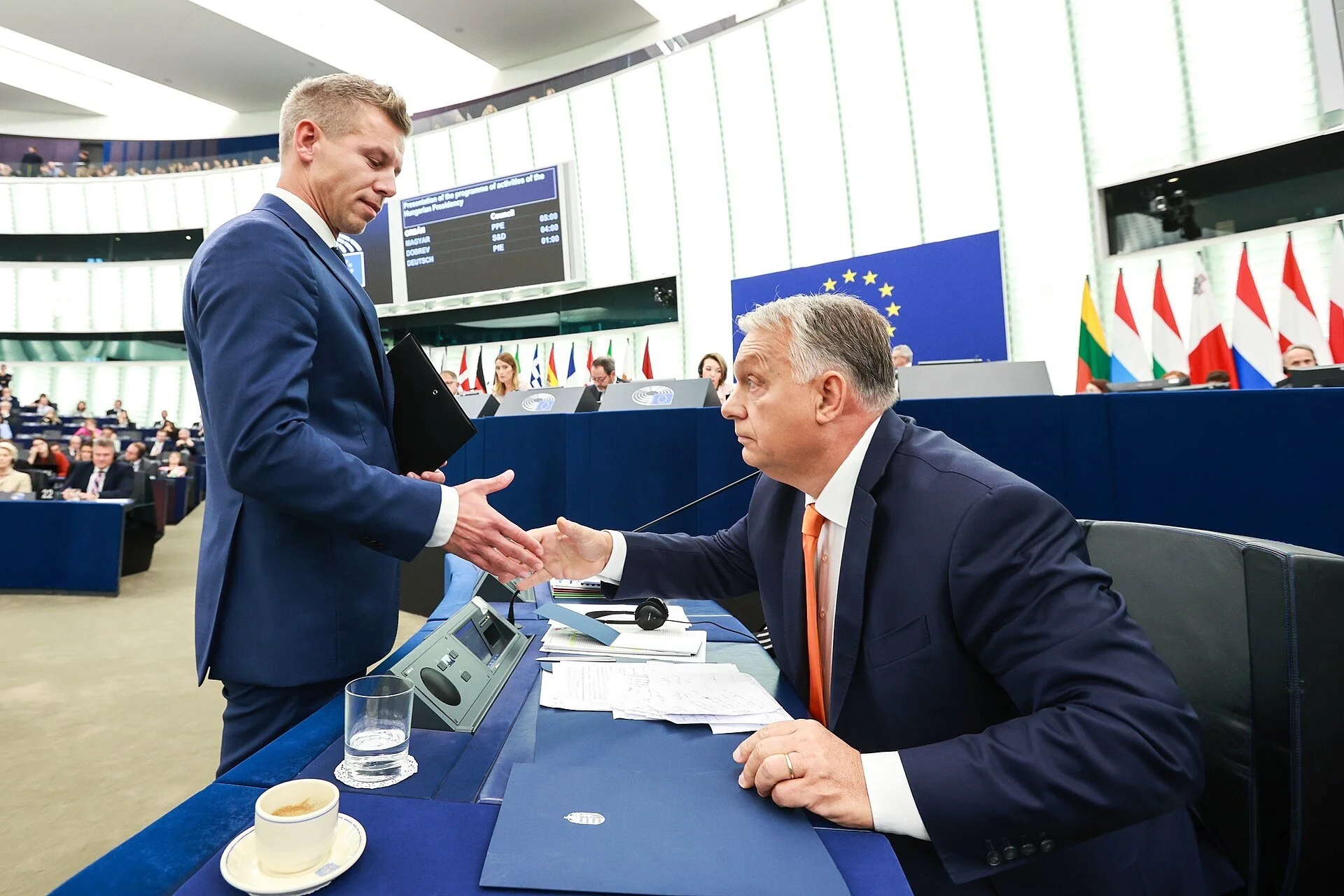
Péter Magyar and Viktor Orbán during a European Parliament plenary session in October 2024. Photo by Alain Rolland, European Union 2024, via Wikimedia Commons
Editor’s Note: This article was prepared before Hungary’s April 12, 2026 parliamentary election and should be read as a pre-election analysis of the race between Viktor Orbán and Péter Magyar.
Péter Magyar, leader of the opposition Tisza party, has emerged as the strongest challenger Prime Minister Viktor Orbán has faced in years as Hungary approaches its parliamentary election on April 12, 2026. According to a CSIS analysis, Tisza was polling at around 48 percent nationally, compared to 39 percent for Orbán’s ruling Fidesz party, in what has become one of the country’s most consequential elections in recent memory.
According to a 21 Research Center survey reported by AP News, voters under 30 support the Tisza party at a rate of 65 percent, compared to 14 percent for the Fidesz party. Among retirement-age voters, the pattern reverses, with Fidesz leading Tisza 50 percent to 19 percent. Between 220,000 and 250,000 Hungarians will also be eligible to cast a ballot for the first time, which gives added weight to the question of whether younger voters will turn out in large enough numbers to influence the result.
Péter Magyar aligned himself with the Tisza party in 2024 after breaking with Fidesz over a presidential pardon scandal involving a man convicted as an accomplice in covering up sexual abuse at a children’s home. The scandal led to the resignation of Hungary’s president, Katalin Novák, a close Orbán ally, as well as Justice Minister Judit Varga. In the European Parliament elections later that year, Tisza won 29.6 percent of the vote, signaling that Magyar had become more than a protest figure. Since then, Hungary’s fragmented opposition has grown more consolidated around Tisza, making it the main challenger to Fidesz across much of the country.
Magyar’s appeal rests in part on the fact that he is not an outsider to the political world he now criticizes. In a CSIS analysis, Donatienne Ruy and Maria Snegovaya note that he is seen as “a more credible, non-corrupt alternative who still has conservative bona fides.” His background as a former Fidesz insider has made him a more acceptable option for voters who oppose Orbán but still hold conservative views on immigration and sociocultural issues. His campaign has centered on dismantling what he calls the “mafia state” built by Fidesz, recovering frozen European Union funds, and rebuilding public services. Orbán, by contrast, has emphasized security and foreign policy, warning that closer alignment with European partners in support of Ukraine would expose Hungary to military conflict and put its access to Russian energy at risk.
The United States has taken a particular interest in Hungary’s parliamentary election, with Secretary of State Marco Rubio visiting Budapest earlier this year, where he endorsed Orbán’s bid for another term and emphasized the close relationship between President Trump and Orbán, according to AP News. Orbán’s governing style has also served as a point of reference for American conservatives, with Trump describing him during a 2024 presidential debate as “a strongman,” “a tough person,” and “smart,” according to the Foundation for Defense of Democracies.
Since 2018, the V-Dem Institute has classified Hungary as an electoral autocracy, while Freedom House has labeled the country as Partly Free and described Fidesz’s constitutional and legal changes as a consolidation of control over independent institutions. Donatienne Ruy and Maria Snegovaya of CSIS argue that electoral rule changes under Fidesz, including gerrymandering and rules that let voters register outside their home districts, have tilted the playing field toward the ruling party. They estimate that Tisza may need to outperform Fidesz nationally by 3 to 5 percentage points to win a parliamentary majority, but even a victory would not quickly dismantle the institutional system Fidesz has built over the past 16 years.
As Hungary approaches its April 12 parliamentary election, Orbán faces his strongest challenge in years from an opposition party that has gained ground across the country. But the contest will take place in a system that still favors Fidesz. Younger voters have backed Tisza by a wide margin, and their turnout could significantly influence the outcome of the election.
Author’s bio: Eli Tannenbaum is a junior at Amherst College double majoring in Political Science and Mathematics, with a certificate in International Relations. His interest in Europe was shaped by a semester at the University of Amsterdam, where he studied Dutch and European Union institutions and conducted comparative research on youth engagement with mainstream media and misinformation.