
Latin America | Elections | Peru
Article By Veronica Martin
May 19, 2026 9:00 am EDT
Peru’s Contested 2026 Presidential Election Heads to June Runoff
Delayed vote counting, fraud allegations, a close race for second place, and an unsettled youth vote have shaped Peru’s 2026 presidential election. With nearly all ballots counted, right-wing candidate Keiko Fujimori and leftist Roberto Sánchez are set to face off in the June 7 runoff.
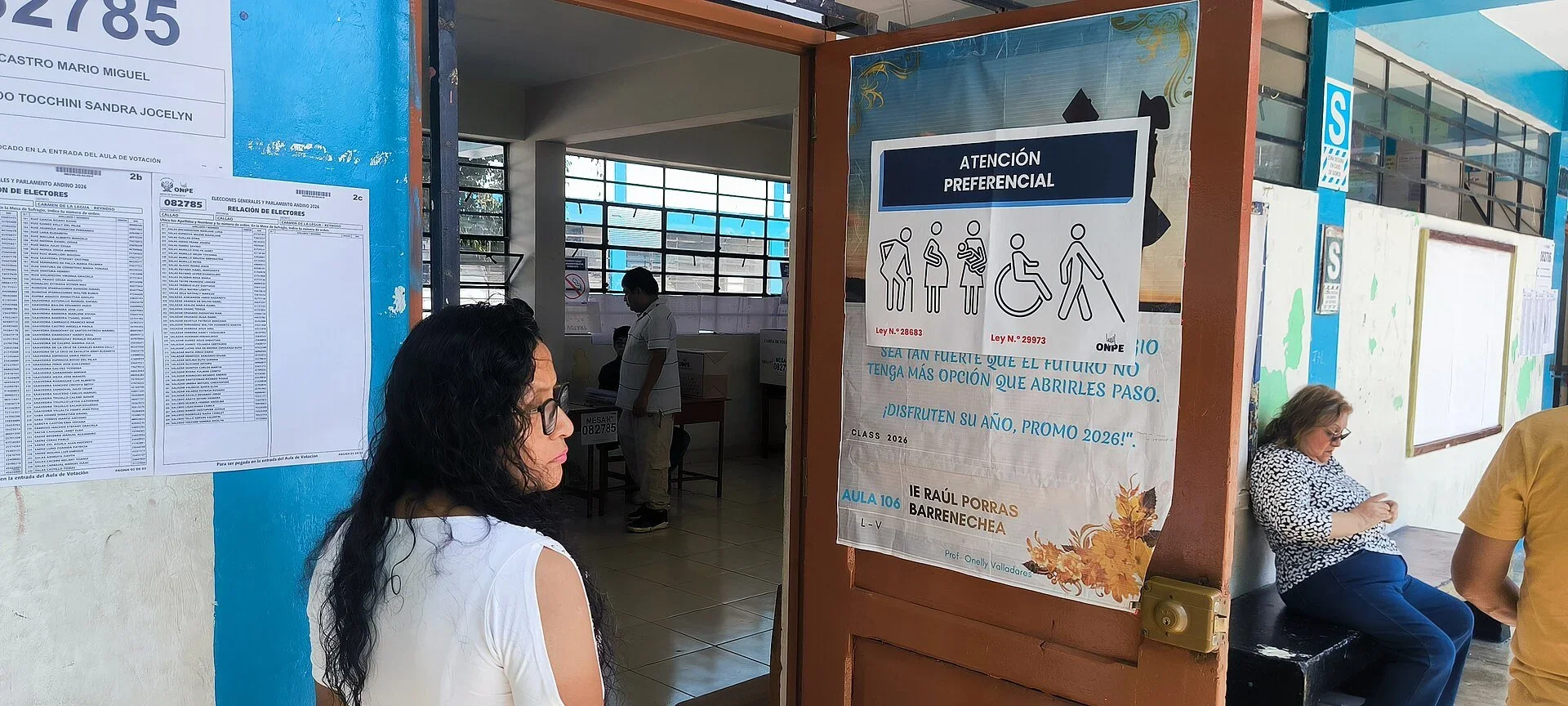
A voter waits outside a polling room at a voting site during Peru’s general election in Callao, Peru, Sunday, April 12, 2026. Photo: Johnattan Rupire/Wikimedia Commons
On April 12, more than 27.3 million Peruvians were eligible to vote in a presidential election that featured 35 candidates, one of the largest presidential fields in the country’s history. Because no candidate reached the 50 percent threshold needed to win outright, Keiko Fujimori, who led with 17 percent of the vote, and Roberto Sánchez, who finished second with 12 percent, will advance to a June runoff.
The election was disrupted by logistical failures after many polling stations failed to receive election materials in time to open, leaving more than 50,000 Peruvians unable to cast their ballots on Sunday and prompting officials to extend voting to Monday, April 13. The National Office of Electoral Processes, known as ONPE, said it would take legal action against Servicios Generales Galaga, the company contracted to transport voting equipment, for failing to deliver the materials in a timely manner. Peru’s national electoral tribunal approved the extended voting period for polling stations that had been forced to close, but two weeks after election day, the ballot count was still incomplete.
Amid the delays, Piero Corvetto, the head of Peru’s National Office of Electoral Processes, resigned under public pressure over the pace of the vote count. In his letter of resignation, which he posted on X, Corvetto explained that he hoped his renunciation would instill greater public confidence in the runoff election. Mounting frustration with ballot delays and logistical failures have raised concerns of fraudulent behavior. However, the European Union’s election observer confirmed that the election met democratic standards.
Rafael López Aliaga and Roberto Sánchez were separated by just over 21,000 votes in the race for second place, but Sánchez ultimately finished ahead of López Aliaga and advanced to the runoff. López Aliaga has since rejected the result and alleged fraud, despite offering no evidence to support the claim. He also asked the National Jury of Elections, known as JNE, to annul the results and informally requested that it suspend the announcement of the second- and third-place finishers, citing logistical failures that he claimed had prevented more than 600,000 Peruvians from voting. Official figures, however, placed the number affected by delayed election materials at roughly 53,000. López Aliaga’s campaign has continued to call for information about possible irregularities, fraud, or sabotage, adding pressure on electoral authorities ahead of the runoff.
The youth vote carried significant weight in this election because young people ages 18 to 29 represented roughly a quarter of Peru’s 27 million-person electorate. According to IPAE Acción Empresarial, more than 6.8 million young people participated in this year’s election, while only four in ten young Peruvians showed interest in politics. Early polling also suggested that younger voters were not firmly aligned with either runoff candidate. A survey by the Institute of Peruvian Studies, known by its Spanish acronym IEP, found that Sánchez drew less support among voters ages 18 to 29 than among older voters, while Fujimori’s support showed little variation by age. IEP also noted that nearly half of young voters would not vote for either Fujimori or Sánchez. Those findings point to a youth vote that is electorally significant but challenging for either runoff candidate to claim, especially in a race shaped partly by Fujimori’s family legacy. Alberto Fujimori, who governed Peru from 1990 to 2000, remains a polarizing figure in the country because of his authoritarian rule, corruption, and convictions for human rights abuses.
Heading into the June runoff, younger voters appear less like a settled bloc than a group still deciding which candidate, if either, can offer a way out of Peru’s long cycle of presidential turnover.
Crime and corruption were among the central concerns for voters in the 2026 election, fueling calls for tougher security measures and a stronger state response to violent crime. It was therefore unsurprising that many candidates placed public safety at the center of their campaigns. Still, the runoff winner will face a difficult path once in office. Neither Fujimori nor Sánchez enters the second round with strong first-round support, and the next president will have to govern alongside a fragmented Congress and a newly restored Senate that could slow or block major legislation.
Author Bio: Veronica Martin is a senior at the University of Texas at Austin studying government and history. Her research interests focus on Latin American foreign affairs, corruption, and democracy.