
Latin America Studies | Peru | Elections
Article By Veronica Martin and Romy Malu
June 20, 2026 9:00 am EST
Peru’s 2026 Presidential Runoff Remains Too Close to Call as Ballot Review Continues
Peru’s June 7 presidential runoff remained unresolved in the days after voters chose between Keiko Fujimori and Roberto Sánchez, two candidates who advanced from a crowded first round marked by low support, ballot delays, and fraud allegations that international observers said were not backed by evidence.
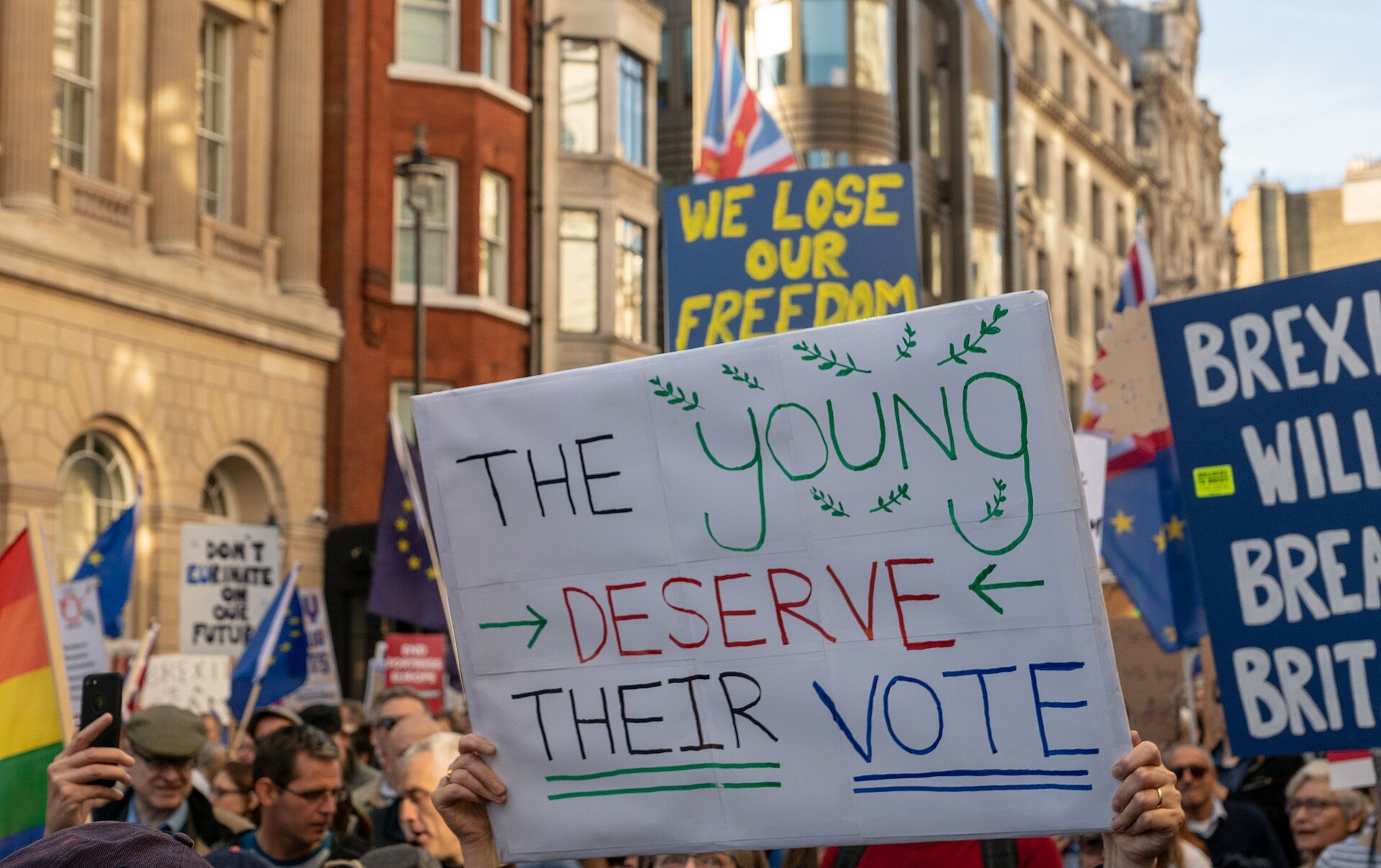
A demonstrator in London holds a sign reading “The young deserve their vote” during the People’s Vote March in 2018. Photo: Colin via Wikimedia Commons
On April 12, Peruvians headed to the polls to vote for the country’s ninth president in 10 years. With 35 candidates on the ballot, no candidate came close to winning the more than 50 percent needed to avoid a runoff. Keiko Fujimori, the conservative leader of the Fuerza Popular party and daughter of former President Alberto Fujimori, advanced to the runoff against Roberto Sánchez, a left-leaning congressman and former foreign trade minister running with Juntos por el Perú, a left-wing Peruvian political party.
Fujimori finished first in the April vote with about 17 percent, while Sánchez finished second with about 12 percent, narrowly ahead of Rafael López Aliaga, the former mayor of Lima. Because more than two-thirds of voters had supported other candidates or cast blank or invalid ballots, the runoff began with both candidates trying to win over an electorate that had not strongly backed either of them in the first round.
Voting Delays and Fraud Allegations Before the Runoff
Beyond the crowded ballot, the April vote was affected by problems at polling stations, where delays in delivering ballots and setting up voting sites left some voters unable to cast ballots on election day. The Guardian reported that voting was extended into Monday after shortages of ballot papers and defective computers disrupted some polling places, including 15 stations in southern Lima where voting had been cancelled because of technical issues. In Lima’s Miraflores district, voters waiting at one polling station chanted, “We want to vote,” while one voter said voting had not begun until about 11:30 a.m. because printers had run out of ink.
The delays quickly became part of the political dispute over the vote after Rafael López Aliaga, who narrowly missed the runoff, claimed fraud and later said he would not accept the results. Election observers and electoral authorities said the logistical failures did not prove fraud, and the European Union observer mission acknowledged serious problems in the process but found no evidence to support a broader fraud claim.
Before the runoff, Peru’s National Jury of Elections (JNE) said officials had taken steps to avoid the same problems by hiring a new logistics company and identifying risks before the second round. JNE President Roberto Burneo acknowledged “difficulties and flaws” in ONPE’s logistical work and said the board had incorporated lessons from the first vote. The JNE also said it would create a committee of national and international experts to improve oversight before the June 7 runoff, making the vote not only a contest between Fujimori and Sánchez but also a test of whether election authorities could avoid a repeat of the April 12 ballot delays and polling-site disruptions.
The Candidates and Their Political Platforms
Fujimori campaigned on economic stability, closer ties with the United States, and a tough-on-crime message that drew in part on her father’s security legacy, while her candidacy also carried the weight of Alberto Fujimori’s presidency, which remains divisive because of his authoritarian rule and corruption convictions.
Sánchez campaigned on constitutional reform, a higher minimum wage, environmental protections around mining, and greater redistribution of mining wealth. Those proposals appealed to parts of Peru’s rural electorate, while also raising concerns among investors over how his government would handle mining, private investment, and the country’s broader economic direction.
Anti-Fujimori Protests Before the Runoff
In Lima, thousands of demonstrators marched against Keiko Fujimori in late May, eight days before the runoff, with many protesters criticizing her candidacy because of her father’s presidency and her family’s return to national politics. Reuters reported that demonstrators filled the streets of Lima on May 30 to oppose her fourth run for the presidency, with protesters chanting “Keiko won’t make it” and carrying banners with the same message.
The protests drew on long-running opposition to Fujimorismo, the political movement tied to Alberto Fujimori’s rule from 1990 to 2000. Alberto Fujimori remains a divisive figure because of his authoritarian rule and corruption convictions, while his government is also remembered for the 1992 self-coup, human rights abuses committed during the fight against insurgent groups, and corruption scandals that continued to shape how parts of the electorate viewed Keiko Fujimori’s candidacy.
For many demonstrators, the runoff was not only a choice between Fujimori and Sánchez, but also a chance to oppose the Fujimori family’s return to the presidency. The late-May march gave that opposition a visible place in the campaign, as protesters used the streets of Lima to argue that the Fujimori name should not return to the presidency.
Youth Participation in the Election
Young voters made up a large share of Peru’s 2026 electorate, with the National Youth Secretariat reporting that 6.89 million voters between the ages of 18 and 29 were eligible to vote, representing 25.2 percent of the national voter roll. That group included more than 2.5 million people between the ages of 18 and 22 who were eligible to vote in a general election for the first time, meaning a significant number of voters entered the race with little or no experience participating in a presidential election.
Although Lima had the largest number of young voters, youth participation was not limited to the capital. The National Youth Secretariat reported that the Lima Metropolitan Area had more than 1.8 million young voters, or 27 percent of the national youth electorate, while Piura, La Libertad, Cajamarca, and Cusco also had large numbers of young voters. Peru’s state news agency Andina also reported that Lima, Piura, La Libertad, Cajamarca, and Cusco had the largest numbers of first-time voters.
The youth electorate also mattered because the concerns identified among young Peruvians overlapped with the issues driving the broader election. According to the National Youth Secretariat, 61.3 percent of young people identified corruption as the country’s main problem, followed by crime, lack of public safety, poverty, low wages or rising prices, and unemployment, which connected young voters’ concerns to a runoff campaign shaped by public frustration over corruption, crime, and Peru’s political direction.
The Close Vote Count
After the June 7 vote, the count shifted as different groups of ballots were processed, with Sánchez gaining ground as votes from rural areas came in and Fujimori later benefiting from overseas ballots, which tended to favor her. By June 12, Reuters reported that the initial count had finished with Fujimori at 9,036,046 votes, or 50.004 percent, and Sánchez at 9,034,743 votes, or 49.996 percent, leaving the candidates separated by just over 1,000 votes out of roughly 18 million cast.
Because the margin was so narrow, the final result depended on the review of contested ballots from more than 1,600 polling stations, representing about 400,000 votes. Ballots can be flagged when tally sheets include calculation errors, unclear writing, or other inconsistencies, and party observers can also challenge results from individual polling stations.
Special electoral juries review those contested tally sheets and decide whether the results can be added to the official count. If a case cannot be resolved through a simple correction, the jury can hold a public hearing, and appeals can later go to Peru’s top electoral court. Reuters reported that electoral authorities expected an official winner to be declared by July 15, although the outcome could become clear earlier if reviewed votes give one candidate a wider lead.
What to Expect Moving Forward
Whoever wins will take office on July 28 with a newly bicameral Congress, as Peru’s April election restored a legislature with a 130-seat lower house and a 60-seat Senate. No party won a majority, meaning the next president will have to work through alliances to pass legislation.
A Fujimori victory could give Fuerza Popular and allied right-wing parties more room to advance their agenda, while a Sánchez victory would likely require broader coalition-building in a divided legislature. In either case, the next president will inherit a government still shaped by public frustration with crime, corruption, and years of presidential turnover.
As election authorities continue reviewing contested ballots, Peruvians are still waiting for a final result in one of the closest presidential races in the country’s recent history. The narrow margin, the number of ballots under review, and the possibility of appeals mean the official winner may not be confirmed for weeks, leaving the next government unresolved even after voters have already gone to the polls.
About the Authors
Veronica Martin is a senior at the University of Texas at Austin studying government and history. Her research interests focus on Latin American foreign affairs, corruption, and democracy.
Romy J. Malu is the Founder and President of Babel Institute. He oversees the think tank’s day-to-day operations and long-term direction.