
Article By Jomalee Smith
June 15, 2026 9:00 am EST | Updated August 12, 2026
What to Know About Ethiopia’s 2026 General Election
Abiy Ahmed’s Prosperity Party won another parliamentary majority as opposition parties raised concerns over political restrictions and voting disruptions.
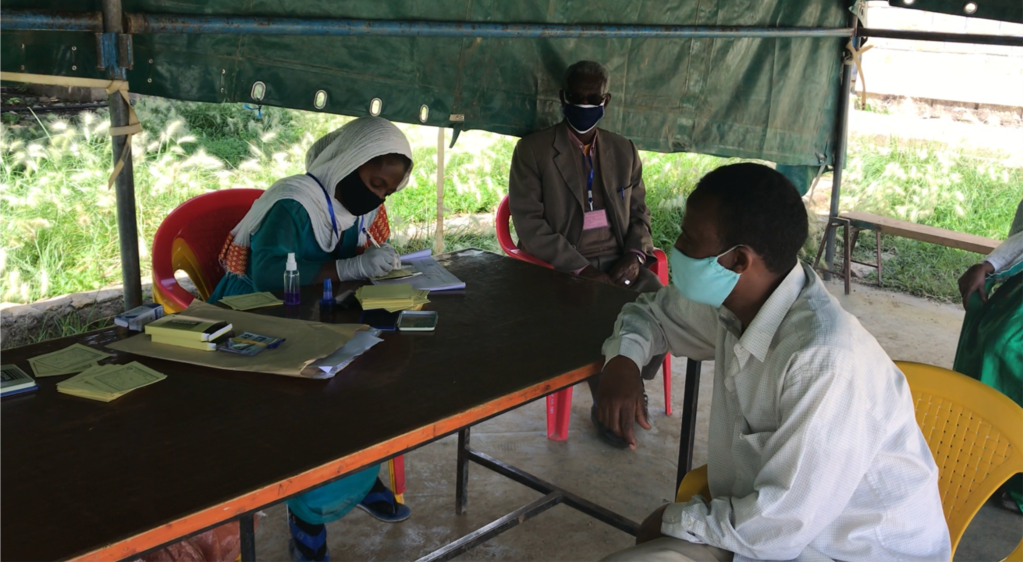
Residents line up during voter registration in Ethiopia’s Tigray region in August 2020. Photo: Mulugeta Atsbeha/Voice of America
On June 1, 2026, Ethiopians voted in parliamentary and regional elections that kept Prime Minister Abiy Ahmed’s Prosperity Party in power. More than 50 million people were registered to vote for members of the House of Peoples’ Representatives, Ethiopia’s national legislature, and for regional councils that help govern the country’s federal states. The National Election Board of Ethiopia reported voter turnout of 94 percent.
Because Ethiopia’s prime minister is chosen through parliament rather than by direct popular vote, the Prosperity Party’s majority guarantees that Abiy will serve another five-year term when the newly elected parliament convenes in October. The Abiy’s ruling party entered the election with a large advantage after winning 410 of the 436 contested parliamentary seats in 2021, while opposition parties said they faced restrictions on political activity and could not freely campaign or meet with voters.
The election came at a difficult time for Ethiopia, as the country is still dealing with the political and humanitarian consequences of the Tigray war, which formally ended with a 2022 peace agreement.
Security Concerns and Voting Disruptions
The Tigray war began in November 2020 after a long political dispute between Prime Minister Abiy Ahmed’s federal government and the Tigray People’s Liberation Front escalated into fighting. The war lasted until a peace agreement was signed in Pretoria, South Africa, in November 2022 after negotiations led by the African Union. The agreement called for a permanent end to fighting, the disarmament of Tigrayan forces, the restoration of federal authority in Tigray, and expanded humanitarian access to communities affected by the conflict. Hundreds of thousands of people are believed to have been killed during the war, and millions were displaced.
Tigray did not participate in the June 1 election after the National Election Board of Ethiopia excluded all 38 of the region’s constituencies because of what it described as “unfavorable conditions” in the region. Weeks earlier, on April 19, former Tigray interim president Getachew Reda warned that the region risked renewed conflict after the Tigray People’s Liberation Front announced plans to restore the regional government that existed before the 2020–2022 war.
In Amhara, voting did not take place in at least eight constituencies where the Fano militia had taken control of parts of the countryside. The affected constituencies were located in South Gondar, West Gondar, Ambassel, and Dega Damot.
The election board reported on June 1 that 143 polling stations did not open because of security concerns, while voting proceeded at 50,188 polling stations across the country. AP reported that it was not immediately clear whether voters at the affected polling stations would be given another chance to cast their ballots.
Prosperity Party’s Advantage Going Into the Election
The Prosperity Party entered the election with a large parliamentary majority from the 2021 vote, when it won 410 of the 436 contested seats in the House of Peoples’ Representatives. Ethiopia’s lower house has 547 seats, and a party needs at least 274 seats to hold a majority. The 2021 election was the first national vote held after Abiy Ahmed created the Prosperity Party in 2019.
Prime Minister Abiy Ahmed took power in April 2018 and founded the Prosperity Party in December 2019 to replace the Ethiopian People’s Revolutionary Democratic Front, the coalition that had ruled Ethiopia since 1991. The new party brought several ruling-party organizations under one national party, while the Tigray People’s Liberation Front refused to join.
Since taking power, Abiy’s government has pushed for economic reforms aimed at reducing the state’s dominant role in parts of the economy and expanding private investment. For example, in 2019, the government introduced its Homegrown Economic Reform Agenda, which called for greater private-sector participation and reforms to state-owned enterprises. Ethiopia later opened its telecommunications market to private competition, and in 2021 Safaricom became the first private telecommunications company licensed to compete with the state-owned Ethio Telecom. The government also pursued the partial privatization of Ethio Telecom and other similar reforms aimed at improving the management and financial performance of state-owned enterprises. These initiatives, along with other economic policies and development projects, gave Prime Minister Abiy and his Prosperity Party a governing record to campaign on as they asked voters for another term.
Forty-seven political parties had 10,934 candidates running in the 2026 general election, including 2,198 for seats in the House of Peoples’ Representatives and 8,736 for regional councils; however, Abiy’s Prosperity Party entered the June 1 general election with a large parliamentary majority it won in 2021 and a record of political reforms and development initiatives to campaign on.
Opposition Claims and Political Restrictions
Abraham Himanot, chairman of the opposition Ethiopian People’s Revolutionary Party (EPRP), told The Reporter Ethiopia that the ruling party had intimidated opposition groups and narrowed their ability to operate ahead of the election. He also said that armed groups in Amhara and Oromia had threatened EPRP members and interfered with the party’s activities. Furthermore, the Associated Press quoted Mistresilasie Tamerat, the head of the EPRP and the youngest candidate in the election, as saying that the electoral process favored the ruling party and that her party could not freely operate or meet with constituents.
In May, the opposition Ethiopian Citizens for Social Justice party, known as EZEMA, said some of its candidates seeking office in Harari’s Jegol constituency had been disqualified because of their ethnic identity. The National Election Board opposed the candidates’ disqualification and challenged the Harari regional council’s action in court. In defense of its decision, the regional council argued that non-Harari candidates could not run for office in Jegol. The court ultimately ruled against the election board, and the EZEMA candidates remained disqualified.
Merera Gudina, chair of the opposition Oromo Federalist Congress (OFC), told The Reporter Ethiopia that opposition parties could not safely move outside Addis Ababa, mobilize campaigns, or send candidates and observers into parts of the country ahead of the 2026 general election as armed conflict and what he described as a breakdown of the rule of law limited political activity. Gudina later told the Associated Press that the election was a “sham” and said the result would “negatively affect the already deteriorating stability of the country.”
The Intergovernmental Authority on Development (IGAD), a regional organization that works on peace, security, and governance across East Africa, sent 26 observers to Ethiopia for the June 1 election. The observers were divided into 11 teams and visited 208 polling stations across Amhara, Oromia, Sidama, Somali, and South Ethiopia, as well as Addis Ababa and Dire Dawa. IGAD reported that voting was peaceful and orderly at most of the polling stations its teams observed.
The African Union Commission sent 73 short-term observers from 35 African countries to Ethiopia after Prime Minister Abiy Ahmed’s government invited the organization to observe the June 1 election. The observers were part of the African Union Election Observation Mission (AUEOM), which is tasked with independently assessing elections across African Union member states. On election day, 27 observer teams visited 495 polling stations across 38 constituencies in Addis Ababa, Oromia, Dire Dawa, Sidama, South Ethiopia, Harari, Benishangul-Gumuz, and Somali. Similar to IGAD’s preliminary report, the AUEOM also concluded that voting was peaceful, transparent, and orderly at the polling stations its teams observed.
African Union election observers also said that the use of digital technology alongside manual voter registration appeared to increase registration, particularly among young people familiar with digital systems.
Youth Participation and Representation
On February 6, the National Election Board of Ethiopia announced that 775 youth volunteers had received training through its Civic and Voter Education department ahead of the June 1 election. The volunteers were trained to provide voter education during voter registration and on election day, including helping voters understand the election process and use the digital voter-registration system. The election board also accredited 169 civil society organizations to provide voter education across the country, and 114 received financial support to reach women, young people, rural communities, and people with disabilities.
The election board reported on May 30 that more than 54 million people had registered for the 2026 general election but did not publish an age breakdown showing how many registered voters were young people. The minimum voting age in Ethiopia is 18, while candidates must be at least 21 years old to run for office.
According to Inter-Parliamentary Union (IPU) data for Ethiopia’s 2021–2026 House of Peoples’ Representatives, 18 of 471 members were age 30 or younger, making up 3.8 percent of the chamber. As of August 12, the IPU has not yet published an age breakdown for the newly elected members, and the election board has not published data showing how many young people voted in the 2026 general election.
What to Watch For
The Prosperity Party won 438 seats in the 547-seat House of Peoples’ Representatives, well above the 274 seats needed for a majority. Because members of parliament select the prime minister, the party has enough seats to elect Abiy Ahmed for another five-year term. Ethiopia’s newly elected parliament is expected to convene in October.
The National Election Board has not announced when voting will take place in the constituencies in Tigray and Amhara that did not participate in the June 1 election. Until those elections are held, the affected constituencies will remain without newly elected representatives in the House of Peoples’ Representatives. Residents of Tigray did not get to participate in the general election and have now gone six years without federal representation.
On August 1, less than six weeks after the election results were announced, fighting broke out near Sheraro in western Tigray between the Ethiopian National Defense Force (ENDF) and Tigrayan forces aligned with the Tigray People’s Liberation Front (TPLF). Both sides accused the other of starting the clashes.
Author Bio: Jomalee Smith is the Director of Africa Studies, overseeing the program’s research on governance, displacement, education, and youth opportunity across the continent.