
United States | 2026 World Cup
Article By Madeline Huang
July 31, 2026 4:00 pm EDT
Beyond the Pitch: The Politics of the 2026 World Cup
The world came to North America for football, but not everyone was welcomed or treated the same.
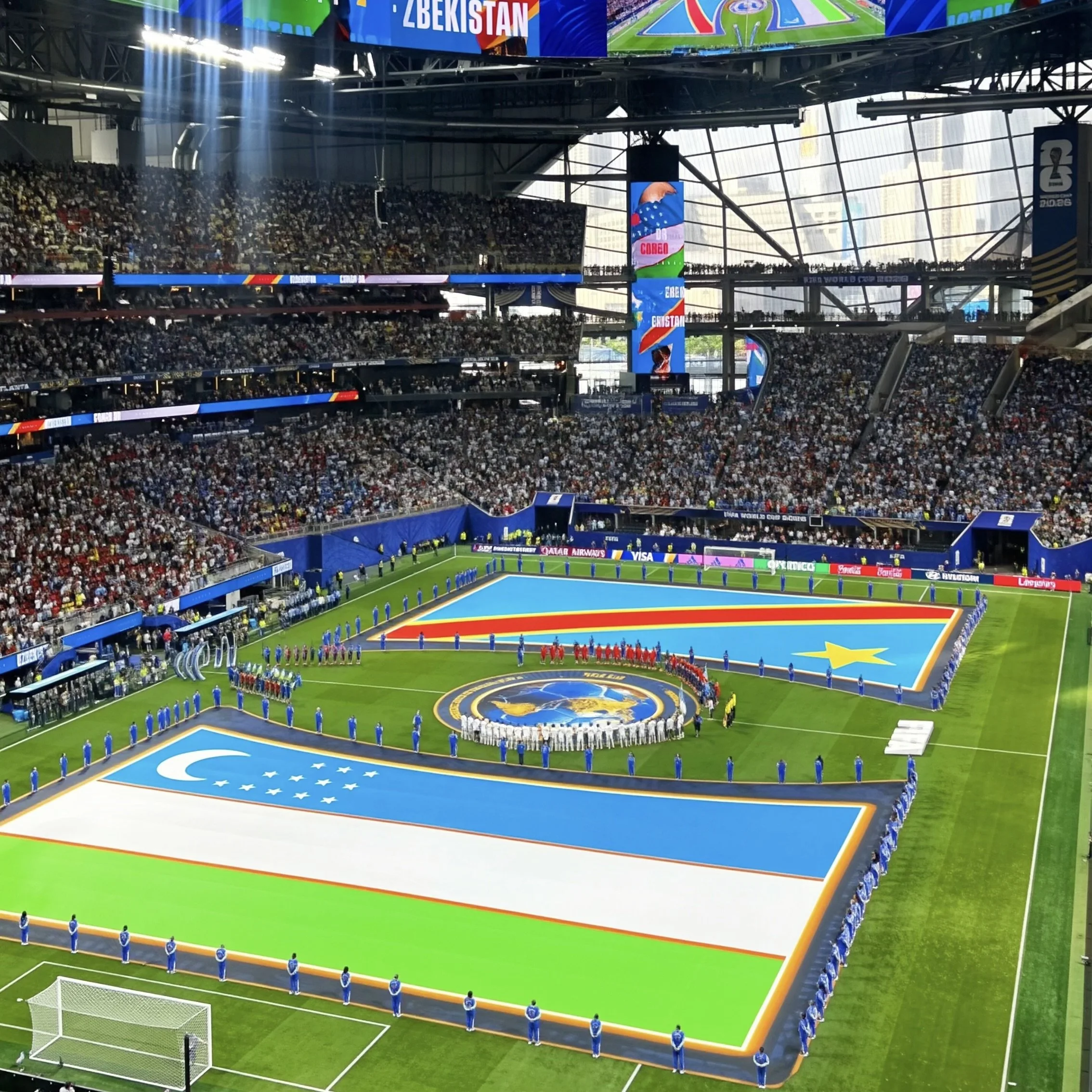
Players from DR Congo and Uzbekistan line up beneath their national flags ahead of their 2026 FIFA World Cup match at Mercedes-Benz Stadium in Atlanta. Photo by Babel Institute.
The 2026 World Cup drew more than 6.8 million spectators to stadiums across Canada, Mexico, and the United States and generated 29 billion video views across FIFA’s digital platforms. People from around the world tuned in to watch the matches from classrooms, homes, and watch parties, often waiting anxiously to see whether their team would prevail. But beyond the roar of fan chants and the buzz of commentators, there was more to this World Cup than a typical soccer frenzy: global conflicts and domestic political tensions turned the pitch into a stage for political theatrics, where divisions among nations, players, and fans became difficult to ignore.
In the months leading up to the 2026 World Cup, FIFA President Gianni Infantino said that the tournament would be the “greatest and most inclusive World Cup ever.” However, U.S. travel restrictions placed on Iran’s national team, visa and entry denials affecting other foreign nationals, and incidents of alleged racist abuse during matches undermined the inclusive image the tournament sought to present.
Iran at the World Cup
Even before Iran played its first match, the conflict had already affected the team’s preparation, as visa delays and U.S. entry restrictions led the team to move its planned base from Tucson, Arizona, to Tijuana, Mexico. The relocation required players to cross the border for every match held in the United States. Fifteen members of the Iranian delegation did not initially receive U.S. visas, including federation officials and support staff, although some were later granted entry to the United States.
For Iran’s first two matches, the U.S. permitted the team to enter the country only one day before each game and required it to return to Mexico immediately afterward. Captain Mehdi Taremi said the restrictions disrupted the team’s preparation and recovery, and that security and immigration checks turned what should have been a short trip into a five-hour journey. The U.S. later eased the restrictions and allowed Iran to arrive in Seattle two days before its match against Egypt.
On June 26, the U.S. launched airstrikes against Iranian missile and drone storage facilities and coastal radar sites after Iran attacked a commercial ship in the Strait of Hormuz, just hours before Iran’s national soccer team faced Egypt in Seattle during the group stage. During the match, a VAR offside call overturned Shoja Khalilzadeh’s apparent winning goal in stoppage time; the decision cost Iran an automatic place in the round of 32, although the team still had a chance to advance depending on the results of other group-stage matches. Iran was eliminated from the tournament the following day after Austria scored a last-second equalizer against Algeria.
In response to the travel restrictions, Iran’s head coach, Amir Ghalenoei, criticized FIFA and the U.S., describing his squad as “the most oppressed” team at the World Cup. He also said the players had been ordered to leave the U.S. immediately after matches, preventing them from remaining overnight to recover.
Despite what the team perceived as unfair treatment throughout the tournament, the players left handwritten notes in dressing rooms in Los Angeles and Seattle thanking both cities for their hospitality and Iranian supporters for standing behind them. In Los Angeles, the team expressed hope for peace, respect, and friendship. And its later note in Seattle stated: “Thank you, Seattle, for your hospitality and thank you to all the Iranians…who gave their hearts, their voices, and their whole being for Iran.”
The Shadow of Trump
When Somali referee Omar Artan arrived at Miami International Airport to join the other officials selected for the World Cup, U.S. authorities denied him entry after questioning him for 11 hours. Artan said he had the proper visa and documentation, while U.S. Customs and Border Protection attributed the decision to unspecified “vetting concerns.” The denial prevented Artan from becoming the first Somali referee to officiate at a World Cup.
Ahead of the United States’ round-of-16 match against Belgium, Trump called FIFA President Gianni Infantino and asked him to review the one-match suspension given to U.S. forward Folarin Balogun. Balogun had received a red card during the previous match against Bosnia and Herzegovina, which ordinarily carried an automatic suspension. FIFA lifted the ban shortly after Trump’s call, allowing Balogun to play against Belgium. On July 6, Trump publicly took credit for prompting FIFA to review Balogun’s suspension while speaking to reporters during an unrelated Oval Office event at the White House. He praised the reversal as the correction of a “great injustice.”
The Union of European Football Associations, or UEFA, accused FIFA of disregarding its own rules for political reasons and called the reversal “unprecedented, incomprehensible and unjustifiable.” The Belgian football association also challenged the decision, but FIFA rejected its appeal because Belgium had not been a party to the disciplinary proceedings.
FIFA’s ultimate decision to lift Balogun’s suspension gave the United States an advantage that few other teams could have expected to receive and turned Trump’s intervention into a display of American power; however, in a hopeful home match against Belgium, the U.S. men’s team suffered a disastrous 4–1 loss. After the match, the Belgian team appeared to reference the controversy in a post on X, formerly Twitter, captioned “Overturn this”, a direct jab at FIFA’s decision to lift Balogun’s suspension. Belgium captain Youri Tielemans told the country’s public broadcaster RTBF that the controversy had motivated his team, which held a meeting after learning that Balogun had been cleared and decided it needed to “do our talking on the pitch.”
Trump had succeeded in convincing FIFA to reconsider Balogun’s suspension, but the criticism surrounding the reversal and the subsequent U.S. loss to Belgium served as a blunt reminder to Trump that the World Cup did not revolve around his efforts to project American dominance on the world stage. The tournament is supposed to be about people from all walks of life coming together through their shared love of football, not political theatrics.
Racism Rears Its Ugly Head
At Argentina’s match against Cape Verde at Hard Rock Stadium on July 3, an Argentine supporter made a monkey gesture toward American streamer iShowSpeed as he filmed from the stands. Videos later circulated online, prompting FIFA to open an investigation into the alleged racist abuse. FIFA condemned the incident and said racism, hate, and discrimination had no place in football or society.
Egyptian fans also accused sections of the Argentine crowd of throwing beer toward them and provoking them after each Argentine goal during Argentina’s round-of-16 match against Egypt. Multiple videos from the stadium also showed Argentine supporters waving Israeli flags toward Egypt’s coaching staff as they left the field. The Egyptian Football Association later called for FIFA to investigate the incidents.
The behavior of some Argentine supporters at the World Cup brought renewed attention to an earlier racism controversy involving Argentina’s national team, in which midfielder Enzo Fernández livestreamed himself and several teammates singing a chant that targeted the African heritage of players on France’s national team shortly after Argentina won the 2024 Copa América. The French Football Federation condemned the chant as racist and discriminatory, while Fernández later apologized and acknowledged that the chant was highly offensive. The livestream incident also renewed scrutiny of Argentina’s long-standing portrayal of itself as a predominantly white and European nation, an image that has often minimized African and Indigenous contributions to the country’s culture and history.
Following Paraguay’s 1–0 loss to France in the round of 16, Paraguayan Senator Celeste Amarilla directed a series of racist insults at French captain Kylian Mbappé on social media, including calling him a “colonized Cameroonian” who was trying to pass himself off as French. Mbappé called Amarilla “despicable” and “unworthy” of her position. Mbappé also stated that the Senator’s racist comments had overshadowed the historic run and effort of Paraguay’s players.
Amarilla later said she had grown up in a generation in which racist and homophobic language was commonly used and acknowledged that she had repeated the same behavior she claimed to oppose. She deleted the posts and retracted some of her remarks, but also demanded an apology from Mbappé, accused him of gender-based violence, and threatened legal action against him.
Paraguay’s government condemned Amarilla’s remarks and said they did not represent the country or its people, while the Paraguayan Senate later passed a resolution condemning her comments. The French Football Federation also filed a complaint with France’s national unit for combating online hate speech, prompting the Paris prosecutor’s office to open an investigation into the matter.
The Bigger Picture
Infantino’s promise of the “most inclusive World Cup ever” was difficult to reconcile with the unequal treatment and racist abuse experienced by some players, officials, and fans.
Still, the tournament produced many powerful moments of unity and inclusivity among fans, including the spread of Norway’s “Viking Row” celebration, which fans around the world reenacted in stadiums, streets, and at watch parties. Norwegian striker Erling Haaland called the celebration “bigger than football.” He later told reporters that seeing thousands of supporters rowing with the team gave him goosebumps.
Cape Verde’s unexpected run to the round of 32 also inspired widespread support around the world, as millions of people cheered for the small island nation. Goalkeeper Vozinha became one of the tournament’s breakout stars, and his Instagram following rose from about 50,000 before Cape Verde’s opening match to more than 20 million during the team’s run.
DR Congo’s historic return to the World Cup also drew global attention and won admiration from fans around the world, with its superfan Michel Kuka Mboladinga quickly becoming one of the tournament’s most recognizable figures. Known as “Lumumba Vea,” Mboladinga stood motionless during matches in tribute to independence leader Patrice Lumumba and became a source of pride for Congolese football fans. Mboladinga was unable to follow the team into the United States after being denied a visa.
These brief displays of global unity and inclusivity during the 2026 World Cup did not erase the unequal treatment or racism surrounding the tournament, but they showed why the event means so much to so many people.
When the camera pans to Spanish fans covered in red and yellow, a group of supporters singing “Hey Jude” at the end of a match, a sea of red, white, and blue Vikings rowing to rhythmic beats, or a small town in a country with a population of 530,000 crying tears of pride for its national team, we, the people, at least for a moment, feel part of something larger than ourselves.
Author Bio: Madeline Huang is a rising sophomore at Barnard College of Columbia University, pursuing a double major in political science and psychology. Her research and analysis focus on pressing issues affecting young Americans and how those issues influence social attitudes.