
Africa Studies | Ethiopia | Elections
Article By Jomalee Smith
June 15, 2026 9:00 am EST
Ethiopia’s 2026 Election Is Expected to Keep Abiy Ahmed’s Party in Power
More than 50 million people registered to vote as the ruling Prosperity Party sought another term in an election marked by delayed results, suspended polling in some areas, and opposition allegations of arrests and campaign restrictions.
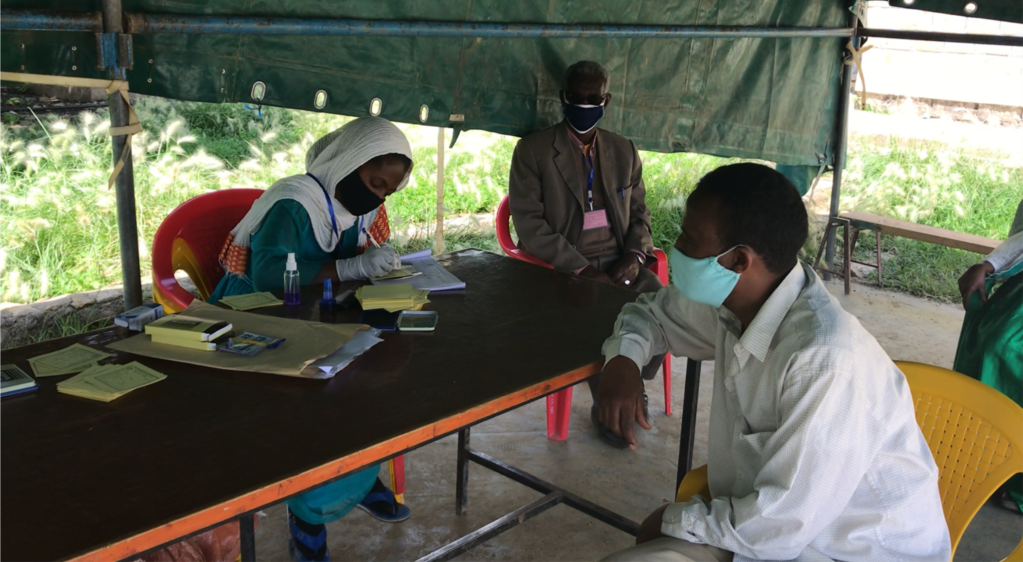
Residents line up during voter registration in Ethiopia’s Tigray region in August 2020. Photo: Mulugeta Atsbeha/Voice of America
On June 1, 2026, Ethiopians voted in parliamentary and regional elections that are expected to keep Prime Minister Abiy Ahmed’s Prosperity Party in power. More than 50 million people were registered to vote for members of the House of Peoples’ Representatives, Ethiopia’s national legislature, and for regional councils that help govern the country’s federal states.
Because Ethiopia’s prime minister is chosen through parliament rather than by direct popular vote, a Prosperity Party majority is expected to keep Abiy in office for another term. The ruling party entered the election with a large advantage after winning 410 of the 436 contested parliamentary seats in 2021, while opposition parties said they faced restrictions on political activity and could not freely campaign or meet with voters.
The election came at a difficult moment for Ethiopia, as the country was still dealing with the political and humanitarian consequences of the Tigray war, which formally ended with a 2022 peace agreement.
Security Concerns and Voting Disruptions
The Tigray war began in November 2020 after a long political dispute between Prime Minister Abiy Ahmed’s federal government and the Tigray People’s Liberation Front escalated into fighting. The war lasted until a peace agreement was signed in Pretoria, South Africa, in November 2022 after negotiations led by the African Union. The agreement called for a permanent end to fighting, the disarmament of Tigrayan forces, the restoration of federal authority in Tigray, and expanded humanitarian access to communities affected by the conflict. Hundreds of thousands of people are believed to have been killed during the war, and millions were displaced.
Tigray did not participate in the June 1 election after Ethiopia’s election board cited “unfavourable conditions” in the region. In Amhara, voting did not take place in at least eight constituencies where the Fano militia had taken control of parts of the countryside. The Associated Press also reported that election-day security incidents in Amhara and Oromia left 143 polling stations unable to reopen, while voting continued at around 50,000 other polling stations across the country.
AP reported that it was not immediately clear whether voters at the affected polling stations would be given another chance to cast ballots.
Prosperity Party’s Advantage Going Into the Election
The Prosperity Party entered the election with a large parliamentary majority from the 2021 vote, when it won 410 of the 436 contested seats in the House of Peoples’ Representatives. Ethiopia’s lower house has 547 seats, and a party needs at least 274 seats to hold a majority.
Prime Minister Abiy Ahmed took power in April 2018 and founded the Prosperity Party in December 2019 to replace the Ethiopian People’s Revolutionary Democratic Front, the coalition that had ruled Ethiopia since 1991. The new party brought several ruling-party organizations under one national party, while the Tigray People’s Liberation Front refused to join.
Since taking power, Abiy’s government has promoted economic reforms, including efforts to open parts of Ethiopia’s state-controlled economy to private investment. His government has also promoted national development projects such as Addis Ababa’s corridor development project, an urban redevelopment effort aimed at expanding roads, pedestrian walkways, bike lanes, green spaces, and other city infrastructure. In agriculture, the government has promoted Ethiopia’s irrigated wheat initiative, which aims to expand domestic wheat production and reduce reliance on imports. In education, school feeding programs have been used to reduce hunger and improve school attendance. The government also launched the National Dialogue Commission to address political divisions and build consensus on national issues. These initiatives, along with other economic policies, development projects, and political reforms, provided the Prosperity Party with a governing record to campaign on as it asked voters for another term.
Forty-seven political parties and more than 10,900 candidates were expected to compete in the federal and regional races, but the Prosperity Party entered the June 1 election as the party already running the federal government and defending the large parliamentary majority it won in 2021.
Opposition Claims and Political Restrictions
Merera Gudina, chair of the Oromo Federalist Congress, told The Reporter Ethiopia that opposition parties could not safely move outside Addis Ababa, mobilize campaigns, or send candidates and observers into parts of the country as armed conflict and what he described as a breakdown of the rule of law limited political activity.
In Amhara, Yesuf Ebrahim, a candidate for the Amhara National Movement, told AFP that his party could not freely conduct election campaigns in many areas because Fano militants had intimidated, harassed, and threatened candidates and supporters.
Reuters reported on May 28 that opposition parties accused the federal government of undermining their campaign efforts by arresting their leaders and imposing legal obstacles to restrict their political activities. The government denied those allegations and said any action against opposition parties was taken in accordance with the law.
Mistresilasie Tamerat, the head of the opposition Ethiopian People’s Revolutionary Party, told the Associated Press that the system favored the ruling party. She also said her party could not freely operate or meet with constituents.
Youth Participation and Representation
Ethiopia’s National Youth Policy defines youth as people between the ages of 15 and 29, a group that makes up about 30 percent of the country’s population. Ahead of the June 1 vote, the National Election Board of Ethiopia included young people in election preparation by training youth volunteers through its Civic and Voter Education department, which worked with regional branch offices.
The state-run Ethiopian News Agency(ENA) reported on May 22 that close to 170 civil society organizations were carrying out awareness-raising activities and training for the electorate in preparation for the election. In Addis Ababa, the same news agency interviewed first-time voters who linked the election to constitutional rights and civic participation. Meqdelawit Hussein, a 12th-grade voter, said, “I am excited to vote for the first time to support a party with better policy alternatives.” Dawit Wondesen, another first-time voter, said, “I will exercise my constitutional right and play a constructive role for the success of the election.”
According to Inter-Parliamentary Union data for Ethiopia’s 2021–2026 House of Peoples’ Representatives, 18 of 471 members were age 30 or younger, making up 3.8 percent of the chamber. It remains to be seen whether interest among young voters in this election will be reflected in the number of young members elected to the new parliament.
What to Watch Next
Final nationwide results had not been released as of the date of this article’s publication. The next development to watch is whether the National Election Board of Ethiopia certifies the results already submitted from most constituencies or delays final certification because of unresolved voting disruptions in parts of Amhara and Oromia.
It also remains unclear whether voters at the 143 polling stations that were unable to reopen on election day will be given another chance to cast ballots. If those voters are not included before final results are certified, opposition parties may use the disruptions to challenge the credibility of the process.
Once the election board releases final results, newly elected members will take their seats in parliament, where a Prosperity Party majority is expected to keep Prime Minister Abiy Ahmed in power.
Author Bio: Jenny Melia is a nonpartisan committee page for the Minnesota House of Representatives. She holds a Bachelor of Science with High Distinction in Sociology of Law, Crime, and Justice from the University of Minnesota.