
Africa Studies | Kenya
Article By Efrata Eshetu
June 15, 2026 4:25 pm EDT
Kenya’s Gen-Z Protests and State-Sponsored Repression
During Kenya’s 2024 and 2025 Gen Z protests, social media helped young Kenyans turn anger over police brutality and a lack of government accountability into mass mobilization, but it also gave authorities new ways to track, intimidate, and punish those demanding change.
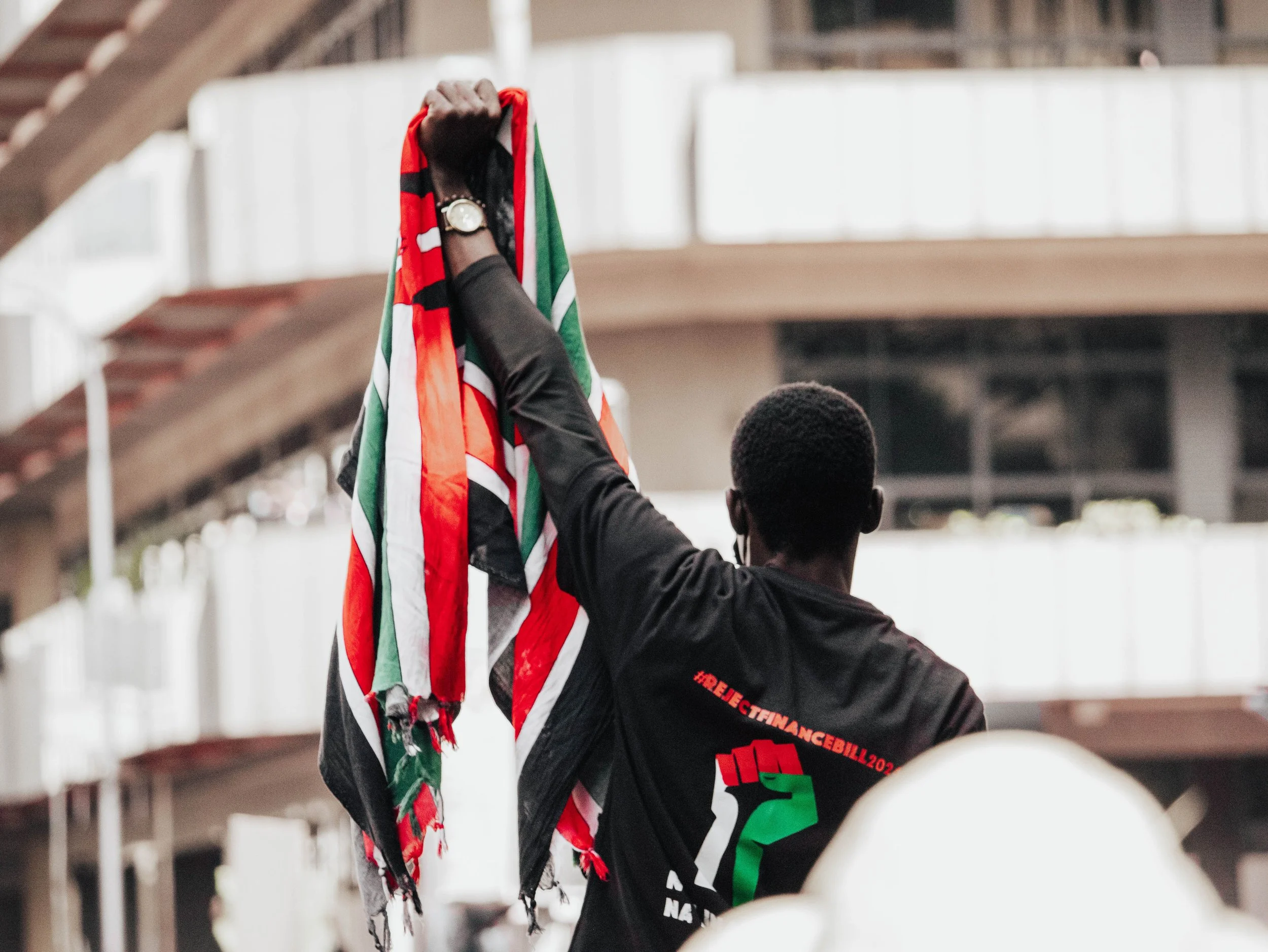
A protester wearing a #RejectFinanceBill2024 shirt holds the Kenyan flag during a demonstration in Nairobi. Photo by MC G’Zay, Pexels.
On June 8, 2025, microblogger Albert Ojwang died in police custody shortly after criticizing a senior police officer on X, formerly Twitter. His death helped trigger Kenya’s 2025 Gen Z protests by turning long-standing anger over government accountability into mass mobilization. As demonstrations spread, social media became both an organizing tool and a source of information for young Kenyans.
During the 2024 Finance Bill protests, hashtags such as #OccupyParliament and #RejectFinanceBill helped users share information, coordinate demonstrations, and draw wider attention to the movement. After Ojwang’s death in 2025, social media again became central as users documented police misconduct, circulated protest updates, and demanded accountability. However, the same social media platforms that helped young Kenyans organize and share information also allowed authorities to monitor, intimidate, and suppress dissent through digital surveillance, targeted arrests, and enforced disappearances.
How Social Media Helped Organize Kenya’s Gen Z Protests
According to the Media Council of Kenya, the June 2024 protests were planned and carried out mainly through platforms such as X and TikTok, where users explained the Finance Bill, followed protest updates, and mobilized around the demonstrations. Instead of moving through party structures or formal opposition leaders, information spread through online conversations as young Kenyans debated the bill, criticized the government’s response, and urged others to join the demonstrations.
On X, Eric, the user behind the account @amerix, hosted “The Citizen’s Assembly,” an X Spaces forum where users discussed the Finance Bill and the government’s response to protesters. Held on July 7 and July 14, 2024, the forum drew about 60,000 listeners, according to the Media Council of Kenya.
On TikTok, videos and livestreams gave users a direct view of the demonstrations as they unfolded, allowing many Kenyans to follow footage from the ground rather than relying only on official government statements. The footage captured scenes of confrontation and police misconduct, while its circulation helped preserve a record of events as they happened. After nationwide internet restrictions were reported during the June 2024 protests, users began sharing instructions for downloading and using VPNs so they could stay connected.
After Albert Ojwang died in police custody in June 2025, Kenyans again used social media to follow the protests as footage from the ground circulated online. Reuters reported that Ojwang had been arrested after allegedly defaming Deputy Inspector General Eliud Lagat online. Protesters later demanded Lagat’s resignation during demonstrations in Nairobi.
Kenyan Authorities’ Social Media Surveillance and Crackdown
As young Kenyans used social media to organize and document the protests, their online activity also made them easier for authorities to identify, monitor, and intimidate. Amnesty International reported that Kenyan authorities deployed social media and digital tools to suppress Gen Z-led protests between June 2024 and July 2025, with young activists facing online threats, arrests, and enforced disappearances.
During the 2024 Finance Bill protests, Amnesty documented cases such as Mariam, a Mombasa-based human rights defender whose name was changed for safety reasons, who received death threats online before police detained her for two nights. Another activist, identified as Joseph, said he received a direct message on X warning, “We are coming for you.”
Amnesty also reported coordinated pro-government posting on X, citing “John,” a pseudonym for a young man who said he ran paid online campaigns for political and commercial clients, including government figures. He told Amnesty that his network used WhatsApp to organize about 20 people, with each person running several accounts to push pro-government messages to Kenyans on X. During large protests, the network created counter-campaigns in response to protest hashtags; for example, John said they answered #RutoMustGo with #RutoMustGoOn.
After Albert Ojwang’s death in police custody in 2025, coordinated posts again targeted protest-related posts online, with Amnesty documenting how posts under #EndPoliceBrutalityKE were countered by accounts pushing the phrase “I Appreciate Police,” which reached Kenya’s top ten trends on X for several hours. On June 24, 2025, another coordinated campaign used #ChaosCartel to accuse Amnesty International of funding protest logistics, including food, transport, and other support for demonstrators, a claim Amnesty described as false. In July, a four-minute AI-generated video spread on TikTok and X, making what Amnesty called unfounded allegations of a plot involving activists, civil society groups, international journalists, and Senator Okiya Omtatah to overthrow the government.
Digital Blackouts and Broadcast Restrictions During the Protests
As the Finance Bill protests grew in June 2024, civil society groups warned that internet access and media coverage could be restricted during demonstrations, a concern the Communications Authority of Kenya rejected on June 24 when it said it had no intention of shutting down the internet or interfering with connectivity. The next day, however, Access Now reported that internet connectivity had dropped nationwide by nearly 40 percent across at least 20 networks, while ARTICLE 19 described the outage as a nationwide restriction on internet access.
Although the exact cause of the June 25 outage remained unclear, its timing raised questions from groups that monitor internet access and freedom of expression, including Access Now, ARTICLE 19, and the Net Rights Coalition. Access Now reported that connectivity had dropped nationwide by nearly 40 percent, ARTICLE 19 questioned why internet access was restricted at the height of the protests, and the Net Rights Coalition (NRC) condemned the shutdown as an attempt to “muzzle protests” against the Finance Bill.
During the June 25 protests, the Communications Authority ordered television and radio stations to stop live broadcasts and warned that continued coverage could lead to regulatory action. Several broadcasters, including NTV, KTN, K24, and Kameme, were later taken off air. KTN said it continued broadcasting on YouTube, Facebook, and X, while a senior official at Nation Media Group, which owns NTV, told Reuters that NTV was live only on YouTube and its website. The Kenya National Commission on Human Rights said the directive violated Article 34(2), which protects media freedom, and Article 35(1)(b), which protects access to information.
Missing Protesters and Alleged Abductions
As videos of arrests and police shootings spread online during the 2024 and 2025 protests, so did reports of protesters going missing or being abducted, with Amnesty International estimating that excessive use of force by Kenyan security agencies during the 2024 and 2025 protests resulted in at least 128 deaths, 3,000 arbitrary arrests, and 83 enforced disappearances.
The Guardian reported in August 2024 that Emmanuel Kamau, a 24-year-old bus conductor from Kasarani, disappeared after leaving home during the protests, with his family searching hospitals, mortuaries, and police stations for nearly two months without finding him. Citizen Digital later reported that Kamau was allegedly arrested in Nairobi’s central business district with a group of protesters but was never presented in court.
By December 2024, the Kenya National Commission on Human Rights said the abductions had increasingly targeted “vocal dissidents, particularly on social platforms.” AP also documented similar accounts of social media users who went missing after sharing AI-generated images of President William Ruto that his supporters considered offensive, while Reuters reported that police later used tear gas to disperse protesters in Nairobi who were demonstrating against the alleged abductions of government critics.
Computer Misuse and Cybercrimes (Amendment) Act, 2025
Kenya’s Computer Misuse and Cybercrimes Act was enacted in 2018 to address cybercrime offences, including provisions on false or misleading data and false publications. During the 2024 and 2025 protests, however, critics said those speech-related provisions had been used against Kenyans for online posts related to the demonstrations.
On June 23, 2025, Joshua Okayo, the president of the Kenya School of Law Students Association, filed a petition seeking changes to Sections 22 and 23 of the Computer Misuse and Cybercrimes Act. Section 22 criminalized false publication, while Section 23 criminalized the publication of false information. Okayo argued that Sections 22 and 23 had been used to punish critics and silence public discussion, citing what he described as a crackdown on Gen Z protesters using social media to express their views.
After President William Ruto signed the Computer Misuse and Cybercrimes (Amendment) Act, 2025, into law on October 15, 2025, the government presented it as part of its effort to address cybercrime, defamation, and harmful online activity. However, Human Rights Watch warned that the amended law risked criminalizing legitimate online speech, while other critics argued that vague restrictions on false or misleading information could give authorities more room to target critics, activists, and protesters online.
For young Kenyans posting criticism of public officials or sharing protest-related information online, the amended Act added legal risks to online activism by making it easier for authorities to treat protest commentary as false publication, defamation, or misinformation.
Gen Z Turned to Social Media to Demand Accountability
Kenya’s Gen Z protesters used social media to turn public frustration into collective action at a time when many young people felt that formal political channels gave them few meaningful ways to demand change from the government. Through X Spaces, TikTok livestreams, protest hashtags, and real-time updates from the ground, young Kenyans found ways to explain the Finance Bill, coordinate demonstrations, and challenge official accounts without relying on political parties or opposition leaders to organize the movement. Even after internet access was disrupted and broadcasters were threatened during the June 2024 Finance Bill protests, young Kenyans continued to rely on social media to share information and keep public attention on the demonstrations.
After Albert Ojwang’s death in 2025, pro-government online campaigns tried to discredit protesters and reshape how the demonstrations were perceived by the general public. But the protests continued, and young Kenyans kept sharing information about the protests and documenting police misconduct.
Social media gave young Kenyans a way to organize and demand accountability, but it also made their protest activity easier for authorities to monitor and punish.
Author Bio: Efrata Eshetu is a third-year undergraduate student at Middlebury College, where she majors in International Politics and Economics and minors in Global Health. Her academic interests center on African migration, women’s rights, and the intersection of religion and policymaking across the continent.