
Latin America Studies | Colombia
Article By Rina Smith & Anna Jones
July 30, 2026 9:00 pm EDT
Left-Wing Candidate Concedes Colombia’s Presidential Election to Trump-Backed Rival
On June 21, Trump-backed conservative candidate Abelardo de la Espriella won Colombia’s presidency after his left-wing opponent, Iván Cepeda, conceded the race.
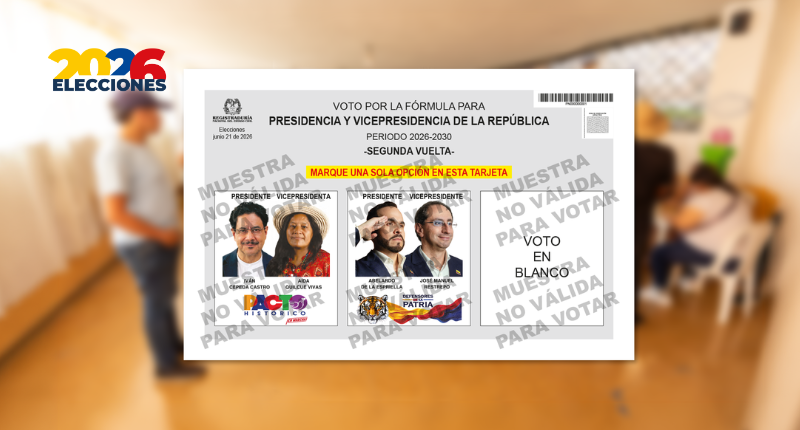
Colombia’s official ballot for the June 21, 2026, presidential runoff featured Iván Cepeda and Abelardo de la Espriella. Image courtesy of the Registraduría Nacional del Estado Civil.
Colombia’s National Electoral Council confirmed Abelardo de la Espriella as the winner of the June 21 presidential runoff after he received 49.66 percent of the vote, compared with 48.70 percent for Iván Cepeda. Cepeda conceded the election on June 24 after initially challenging the preliminary results and requesting additional scrutiny of the vote count. On June 30, Cepeda threatened to organize “peaceful civil disobedience” if De la Espriella did not renounce his U.S. citizenship, which Cepeda argued could create a conflict of interest.
The 2026 presidential election came at a time when the country has been facing increased violence and instability involving armed groups, along with renewed concerns about political violence following the June 2025 shooting of Senator and presidential hopeful Miguel Uribe Turbay. Colombian prosecutors have alleged that leaders of Segunda Marquetalia, a FARC dissident group, ordered the attack. Uribe died from his injuries two months later.
Cepeda, a close ally of Colombia’s outgoing left-wing president, Gustavo Petro, proposed what his campaign called a “comprehensive peace” policy, which focused on implementing the 2016 peace agreement with the Revolutionary Armed Forces of Colombia and continuing some negotiations with armed groups. His proposal differed from Petro’s “total peace” strategy, under which the government pursued negotiations and ceasefires with several armed groups. Several of those negotiations later stalled or collapsed, while armed groups continued fighting over territory used for drug trafficking and illegal mining operations.
De la Espriella, who calls himself “El Tigre” (“The Tiger”), campaigned on ending negotiations with armed groups and increasing the use of military and law-enforcement operations. His proposals included constructing 10 megaprisons, expanding the armed forces, and eradicating coca crops. He also called for closer security cooperation with the United States, including greater intelligence sharing and assistance with operations against drug trafficking.
Paramilitary allegations and election fraud claims
Ten days before the June 21 runoff, Cepeda filed a criminal complaint against De la Espriella with Colombia’s Attorney General’s Office and submitted information concerning the allegations to the International Criminal Court, alleging criminal conspiracy, terrorism financing, and illicit enrichment connected to paramilitary groups. The complaint centered on De la Espriella’s involvement with the Foundation for Peace Initiatives (FIPAZ), an organization that Cepeda alleged received funding from the United Self-Defense Forces of Colombia (AUC) and provided the paramilitary group with financial and logistical support. Cepeda also alleged that FIPAZ worked to prevent the extradition of AUC commanders to the United States. De la Espriella denied the allegations.
De la Espriella also faced scrutiny over his previous representation of Alex Saab, a close ally of Nicolás Maduro who was charged in the United States with money laundering before being released in a 2023 prisoner exchange. De la Espriella represented Saab from 2013 until 2018 or 2019, according to different accounts, and has said that his work was limited to providing legal counsel. The relationship drew renewed attention during the campaign after reporting showed that companies associated with Saab transferred more than $370,000 to accounts connected to De la Espriella in 2014. De la Espriella has denied participating in Saab’s alleged criminal activity.
De la Espriella also previously represented David Murcia Guzmán, who operated DMG, a company that Colombian authorities identified as a large pyramid scheme before its collapse in 2008. De la Espriella has argued that representing clients accused of crimes does not mean that he supported or participated in their conduct.
After the runoff, President Petro questioned the election results and accused the United States and Israel of interfering to help De la Espriella win. He also alleged that foreign actors had accessed computer systems belonging to Colombia’s National Registry and manipulated digitally displayed information associated with Form E-14 tally sheets, which poll workers complete at individual voting stations. Petro said requests for a technical audit of the voting software had been ignored but did not publicly provide evidence showing that the vote count had been altered.
Gregorio Eljach, the head of Colombia’s independent public-oversight agency, rejected Petro’s allegations, saying there was no evidence of electoral fraud.
The Youth Vote in the Election
Nearly six million young Colombians were eligible to vote in the 2026 election, representing approximately 15 percent of the country’s 41.4 million registered voters. At a June 17 forum with first-time voters, Cristian Quiroz, president of Colombia’s National Electoral Council, said the council estimated that approximately 60 percent of eligible young voters did not participate in elections, although he did not specify which previous elections were used to calculate that figure. The council organized the forum to encourage young Colombians to vote in the June 21 runoff.
A January 2026 report by Next Gen C, a research initiative that studies youth participation in Colombia’s political and social development, found that young respondents were particularly concerned about healthcare, public safety, and employment. The organization surveyed people between the ages of 18 and 32, with 51 percent identifying limited access to healthcare as one of the most significant problems facing young people, while 49 percent cited insecurity in the streets and 44 percent cited a lack of employment opportunities. Among those surveyed, 66 percent said they intended to vote in the presidential election, although 74 percent of that group had not decided which candidate to support. Only 28 percent expressed confidence in political parties.
Ahead of the runoff, young K-pop fans formed Movimiento Kpopers por el Pacto Histórico after concluding that Cepeda’s campaign was not reaching enough voters online. The group’s WhatsApp channel grew to 5,218 members within several days and became a place for participants to share information, create infographics, challenge false claims, and coordinate posts across TikTok, Instagram, and X. Members also produced videos explaining Cepeda’s proposals, including his plan to expand access to free public universities. The organizing began independently of Cepeda’s official campaign, although he later publicly thanked the group for its support.
Co-author: Rina Smith is a fourth-year student at The Ohio State University, majoring in international studies and Spanish with a minor in social justice advocacy and public policy. Her academic interests include Central and South American politics and Indigenous rights.
Co-author: Anna Jones is a junior at New York University studying international relations and environmental studies. At NYU, Anna is a founding member of the Kappa Alpha Pi pre-law fraternity, captain of the Competitive Cheer Team, and a resident assistant.