
Article By Lila Li
September 23, 2026 7:00 am EDT
Scripture as Literature: Texas’ New Reading List Puts the First Amendment on the Syllabus
The push to replace Mercator maps is forcing governments and institutions to reconsider how geography shapes perceptions of Africa.
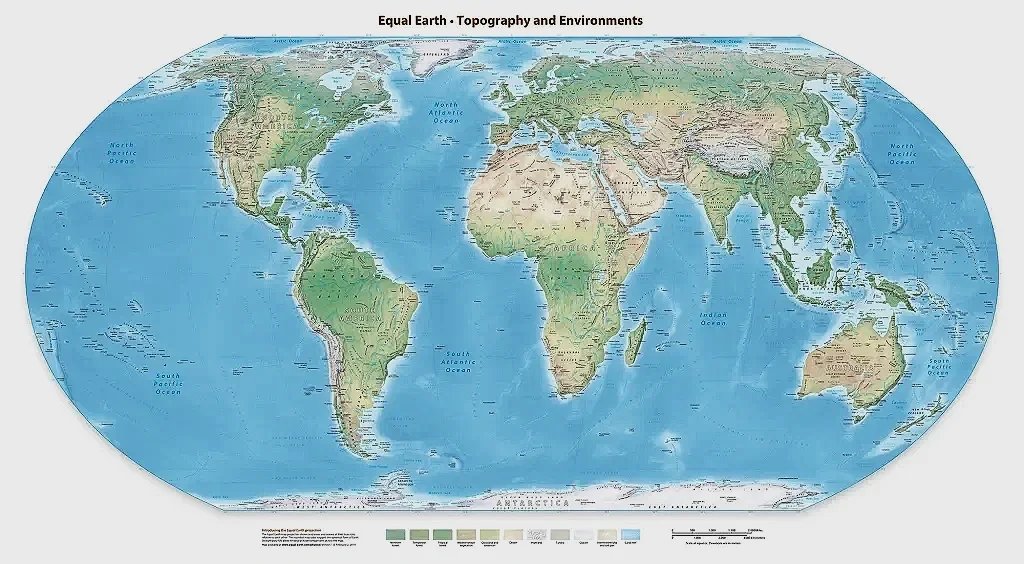
The Equal Earth projection preserves the relative area of continents and landmasses and is one of the equal-area projections promoted by the United Nations’ “Correct the Map” resolution. Map credit: Tom Patterson/Equal-Earth.com
Twenty-nine Bible verses and stories have become required reading for 5.5 million K-12 public school students in Texas with the State Board of Education (SBOE)’s approval of a contentious statewide mandatory literary works list by a 9-5-1 vote on June 26th, with all nine votes in favor coming from Republicans. The list is set for a 2030-31 implementation timeline.
Each year of instruction has at least one Bible verse or story required, with students exposed to different stories depending on their grade level: first-graders will read Jonah and the Whale; fifth-graders chapters 3 and 14 of Moses (Book of Exodus); English II (high school sophomore) students fifteen chapters of The Book of Job. Altogether, there are 29 Bible selections among 190 total required readings—15.3% of the list; Democratic legislators have criticized the list as affording a disproportionate share of instructional time to a single faith tradition.
Schools are likewise required to teach specific translations of said passages; the requirements in particular favor the King James translation, consequently prioritizing Christian—specifically Protestant—interpretations and perspectives over those of other religions. Which translation/s are used in the classroom has been contested since the mid-19th century, which saw frequent clashes between Protestants and Catholics over which Bible and which prayers were appropriate for classroom use, with the latter indeed concerned over the use of the King James version. Under Secretary of Education Linda McMahon, the Department of Education (DoE) released revised guidance on religious expression in public schools in February 2026, requiring that schools “do not favor… one religious view over another”.
Texas is the first state to enact a mandatory statewide standardized reading list for every single grade level. The original required reading list was designed and proposed by the Texas Education Agency in 2023 as a result of House Bill (HB) 1605, which required the SBOE to specify a vocabulary and book list addendum to the reading language arts standards for each grade level. This list faced criticism for having too many texts per grade, its inclusion of Bible stories, and a lack of authorial and viewpoint diversity.
These developments come in the broader context of Texas’ sustained efforts to incorporate religious materials into public schools. In 2024, a Bible-infused curriculum textbook—known as “Bluebonnet”—approved by Texas for public schools met controversy and pushback after hundreds of factual and grammatical errors were discovered by teachers and education officials—after the material was introduced to classrooms. In 2025, the Legislature passed and Texas Gov. Greg Abbott signed Senate Bill 10, requiring every public school classroom to display the Ten Commandments. In response, a group of Texas families with children in public schools—represented by the ACLU of Texas, Americans United for Separation of Church and State, and the Freedom from Religion Foundation—filed a federal lawsuit; the still-ongoing Nathan v. Alamo Heights Independent School District (2025) found success at the district court, but this decision was later struck down by the en banc U.S. Court of Appeals for the Fifth District. Similar cases have been recorded in Pennsylvania’s Kitzmiller v. Dover Area School District (2005), which ruled that it was not unconstitutional for a Pennsylvania school board to require ninth-grade biology teachers to present intelligent design as an alternative to evolution; in Louisiana Governor Jeff Landry’s signing of House Bill 71, which mandates that Ten Commandments be displayed in classrooms; and in Oklahoma State Superintendent Ryan Walter’s order that public schools incorporate the Bible into their lessons.
The June 26 vote was largely politicized, with SBOE members expressing concern over the “rushed” nature of the process and that it took place along mostly partisan lines: in signed letters to the SBOE, 61 Republican state representatives described the proposed list in as a “long-overdue restoration of academic rigor and cultural grounding,” while 46 Democratic legislators instead criticized it—like its 2023 predecessor—for its scope, factual errors, and required instructional time, arguing that its inclusion of biblical passages was “drawn exclusively from one faith tradition, with gaps in cultural representation”. The parties’ disagreement stems from whether the list teaches religion’s impact on U.S. history—which courts have permitted—or teaches religion itself—which they have not.
Nathan Irving, a pastor and father of eight from Myrtle Springs, Texas, defended the passage as necessary context for the nation’s history and morals, positing that “this country and this state were founded upon a Christian worldview”. Republican SBOE member Brandon Hall affirms this, arguing that “understanding key biblical passages is really important to a complete education” for the Bible’s impact on “our culture, our laws, and our history as Texans and Americans”. These supporters’ arguments rest on the premise that reading biblical texts is crucial for literacy and historical understanding, given that Judeo-Christian values are foundational to American laws and culture.
This perspective of the Bible as an academic tool is supported by the Supreme Court’s statement in Abington School District vs. Schempp (1963) that “it certainly may be said that the Bible is worthy of study for its literary and historic qualities”. In the decision, the Supreme Court banned organized Bible reading for religious and moral instruction, but stated that “nothing we have said [in the decision] indicates that such study of the Bible or of religion [for its literary and historic qualities] may not be effected consistently with the First Amendment.”
Federal guidance has said much the same thing. The DoE’s official guidance on constitutionally protected religious expression in schools, issued in 2023 under Secretary Miguel Cardona and in effect until February 2026, established that “religious texts as literature and the role of religion in the history of the United States and other countries are… permissible public school subjects.” This means that districts receiving federal funds must certify in writing each year that they maintain no policy denying participation in constitutionally protected prayer as the guidance describes it. Members of the court have also occasionally suggested that public schools may “teach the Bible as literature” (Pew).
The list’s critics—including but not limited to the organizations representing the plaintiff in Nathan v. Alamo Heights Independent School District and the Democratic legislators who signed against the list—make the opposing claim that the decision could violate the First Amendment’s Establishment Clause that “Congress shall make no law respecting an establishment of religion”—and historical religious neutrality precedents in the American education system. The Establishment Clause was ruled applicable to the states by the Supreme Court in Cantwell v. Connecticut (1940) and Everson v. Board of Education of Ewing Township (1947).
The DoE’s guidance distinguished between “provid[ing] religious instruction”---previously forbidden for schools—and “teach[ing] about religion,” which was permitted. It dictated that schools must “maintain neutrality among faiths rather than preferring one or more religions over others”, and that “teachers… may not lead students in prayer, devotional readings, or other religious activities”.
Objections have not come only from a secular perspective: Christian mother Megan Boyden from Denton, Texas, expressed concerns over the required readings’ potential impact on her private faith, claiming: “It is my right and responsibility to teach our family’s religion. It is not the state’s job to shed through the lens of a teacher who may not share the same beliefs I do” (Hollingsworth). Rabbi David Segal, policy counsel for Baptist Joint Committee for Religious Liberty, echoed this sentiment, claiming the “[SBOE] is… taking away [children, parents, and teachers]’ freedom of conscience and religious liberty.
Students from both non-Christian and nonreligious families are left with a narrow set of options. Both previous and current guidance advocates a “stance of neutrality among and accommodation toward all faiths,” and parents may opt their children out of readings that “conflict with their religious and moral beliefs”; however, students could still be tested on these readings.
Author Bio: Efrata Eshetu is a fourth-year undergraduate student at Middlebury College, where she majors in International Politics and Economics and minors in Global Health. Her academic interests center on African migration, women’s rights, and the intersection of religion and policymaking across the continent.