
Article By Ashley Watermeier
July 16, 2026 10:30 am EDT
Supreme Court Clears the Way for Trump to End TPS for Haitians
The 6-3 ruling limits judicial review of TPS termination decisions and clears the way for the administration to end protections for approximately 350,000 Haitians.
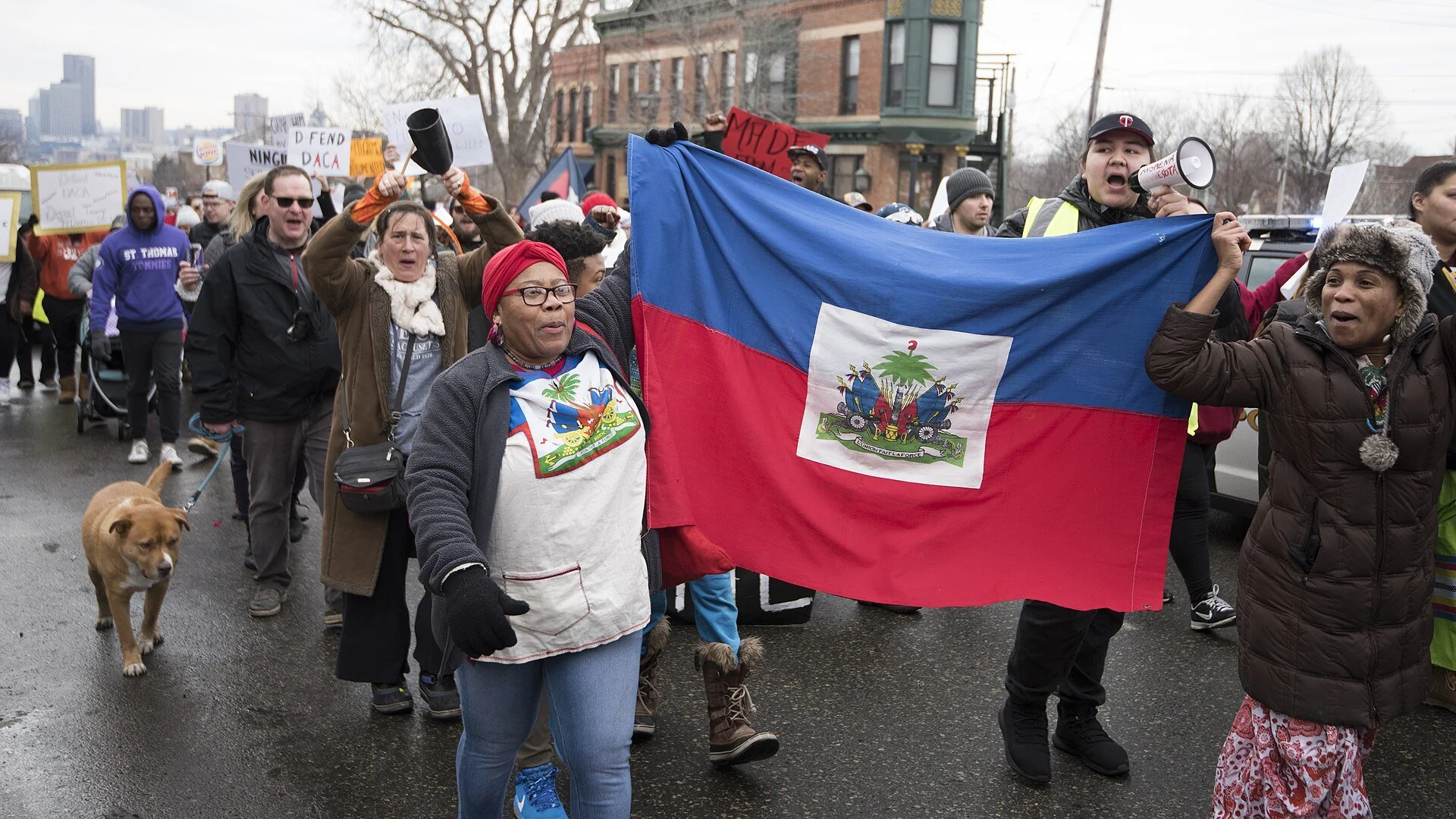
Demonstrators march in support of Temporary Protected Status and other immigration protections in St. Paul, Minnesota, on January 20, 2018. Photo: Fibonacci Blue/Flickr.
On June 25, 2026, the Supreme Court cleared the way for the Trump administration to end Temporary Protected Status for approximately 350,000 Haitians living in the United States. In the consolidated cases Trump v. Miot and Mullin v. Doe, the justices ruled 6-3 that federal law bars courts from reviewing the plaintiffs’ nonconstitutional challenges to the Department of Homeland Security’s decisions to terminate TPS for Haiti and Syria.
The decision did not determine that conditions in Haiti had become safe or that Haiti no longer qualified for TPS. Instead, the Court concluded that Congress had largely prevented federal courts from reviewing the process through which the homeland security secretary designates, extends or terminates a country’s TPS designation. The majority also determined that the Haitian plaintiffs were unlikely to prove, at this stage of the litigation, that race was a motivating factor in the decision to terminate Haiti’s TPS designation.
The ruling reversed the lower-court orders that had temporarily postponed the TPS terminations for Haiti and Syria and returned both cases to the lower courts for further proceedings. Although the decision directly involved Haitian and Syrian TPS holders, the Court’s interpretation of the statute could make it more difficult to bring similar nonconstitutional challenges against future TPS termination decisions.
Haiti’s TPS designation
Congress created TPS in 1990 to provide temporary protection to eligible nationals of countries experiencing armed conflict, environmental disasters or other extraordinary conditions that prevent their safe return. During a country’s designation period, qualifying recipients may remain in the United States, obtain authorization to work and receive protection from removal. TPS does not, however, automatically provide lawful permanent residence or another permanent immigration status.
Haiti was first designated for TPS on January 21, 2010, after a magnitude 7.0 earthquake devastated the country, killing hundreds of thousands of people and displacing more than 1.5 million. The initial designation lasted 18 months and was subsequently extended as Haiti faced continuing humanitarian crises, including a cholera outbreak, hurricanes, political instability and another major earthquake in 2021.
The first Trump administration announced in 2017 that it would terminate Haiti’s TPS designation, with the termination scheduled to take effect in July 2019, but lawsuits and court orders required DHS to continue the protections while the cases proceeded. The litigation was later dismissed after subsequent TPS designations made the challenges moot.
Under President Joe Biden, DHS designated Haiti for TPS again in 2021 and later extended and redesignated the country in 2023 and 2024. The 2024 decision would have kept the designation in effect through February 3, 2026. After President Donald Trump returned to office, then-Homeland Security Secretary Kristi Noem partially reversed the 2024 decision by shortening the designation’s scheduled duration from 18 months to 12 months and moving its expiration date to August 3, 2025.
DHS initially announced in July 2025 that the designation would terminate on September 2, 2025. Later that month, however, the U.S. District Court for the Eastern District of New York ruled in a separate case that the designation could not end before February 3, 2026. In November 2025, DHS issued a new notice terminating Haiti’s designation effective February 3, 2026. Five Haitian TPS holders then sued in the U.S. District Court for the District of Columbia, arguing that the November 2025 termination decision violated required procedures and was influenced by racial discrimination.
The district court granted interim relief that prevented DHS from immediately ending Haiti’s designation, and the U.S. Court of Appeals for the D.C. Circuit declined to pause that order. The administration then asked the Supreme Court to hear the case before the appeals court issued a final judgment. The justices agreed to consider it alongside Mullin v. Doe, which involved the termination of TPS for Syrians.
The Haitian plaintiffs’ argument
The Haitian plaintiffs argued that Noem had violated the Administrative Procedure Act by prejudging the termination and failing to follow procedures required by the TPS statute. Under federal law, the homeland security secretary must consult appropriate government agencies and review conditions in the designated country before deciding whether to extend or terminate TPS.
The plaintiffs alleged that the consultation process was inadequate because government communications did not meaningfully address whether conditions in Haiti had become safe enough for people to return. They also argued that DHS acted arbitrarily and capriciously by failing to adequately consider evidence of continued gang violence, political instability and deteriorating humanitarian conditions in Haiti.
Their constitutional claim alleged that the decision violated the equal-protection component of the Fifth Amendment’s Due Process Clause because race was a motivating factor in the termination. The plaintiffs cited statements by Trump and Noem that they argued demonstrated racial hostility toward Haitians and other nonwhite immigrants.
The administration’s argument
The Trump administration argued that the TPS statute expressly prohibits judicial review of DHS decisions concerning the designation, extension or termination of a foreign country’s TPS status.
The relevant provision, 8 U.S.C. § 1254a(b)(5)(A), states that there is no judicial review of any determination by the homeland security secretary concerning “the designation, or termination or extension of a designation, of a foreign state” under the TPS statute.
The administration maintained that this language barred not only challenges to the secretary’s ultimate decision but also non-constitutional claims involving procedural or subsidiary decisions, including consultations, country-condition assessments and other steps leading to that decision.
The Court’s opinion
Justice Samuel Alito announced the Court’s judgment; Chief Justice John Roberts and Justices Clarence Thomas and Brett Kavanaugh joined his opinion in full, while Justices Neil Gorsuch and Amy Coney Barrett joined all but one section. Thomas also wrote a separate concurring opinion.
The majority concluded that the statutory language was broad enough to prohibit courts from reviewing the plaintiffs’ non-constitutional claims. According to the Court, the word “determination” could encompass both the secretary’s final decision and the administrative process leading to it. The Court therefore rejected the plaintiffs’ effort to distinguish between the ultimate termination and DHS’s compliance with required procedural steps.
The Court did not independently assess whether conditions in Haiti justified terminating TPS. Instead, it held that Congress had placed that assessment, along with the process used to reach it, largely beyond judicial review.
The Court separately addressed the Haitian plaintiffs’ equal-protection claim, assuming without deciding that heightened scrutiny applied to the claim and that the plaintiffs needed to show that racial discrimination was a motivating factor in the termination. It concluded that the plaintiffs were unlikely to establish that race had influenced the decision.
Alito wrote that none of the statements cited from Trump or Noem was overtly racial and that they could be explained by the administration’s broader opposition to immigration and its objections to how previous administrations had implemented TPS. The Court also noted that the administration had terminated every TPS designation that had come up for review, involving countries across several regions and racial or ethnic populations.
The Court therefore concluded that the plaintiffs were not entitled to interim relief. It reversed the district court judgments and returned the cases to the lower courts for further proceedings consistent with its opinion.
Justice Thomas’s concurrence
Justice Thomas joined the Court’s opinion in full but wrote separately to argue that the Haitian plaintiffs’ constitutional claim was also barred by the TPS statute’s prohibition on judicial review. He further argued that noncitizens have no equal-protection right against the federal government when challenging an immigration-status decision, a position the other five justices in the majority did not join.
The dissent
Justice Elena Kagan wrote the dissent, joined by Justices Sonia Sotomayor and Ketanji Brown Jackson. Kagan argued that the statute prevented courts from reviewing the secretary’s ultimate decision to extend or terminate TPS but did not prevent them from determining whether DHS followed procedures that Congress explicitly required.
According to Kagan, the secretary was required to consult appropriate agencies about whether conditions in Haiti and Syria had become safe. She argued that the communications cited by DHS asked whether terminating TPS presented foreign-policy concerns rather than whether conditions in the two countries allowed people to return safely. She therefore concluded that DHS had not fulfilled the statute’s consultation requirement.
Kagan also argued that the district court had sufficient evidence to conclude that race may have played a role in the decision concerning Haiti. She emphasized that racial discrimination did not have to be the sole or primary reason for the termination. Instead, the plaintiffs only needed to show that it was one motivating factor.
The dissent maintained that the majority had discounted the statements by Trump and Noem and had failed to give appropriate deference to the district court’s factual findings. Kagan would have upheld the lower courts’ interim orders postponing the TPS terminations while the litigation continued.
What happens next
The Supreme Court’s decision allows the administration to proceed with ending TPS for Haitians, but it did not itself establish a new termination date, order individual recipients to leave the country or determine whether every Haitian TPS holder is subject to deportation. Once TPS ends, recipients generally return to any immigration status they held before receiving TPS or to another status they lawfully obtained while protected. Those without another valid status or an individual basis for remaining in the United States, such as a pending asylum application, may become vulnerable to detention and removal. The ruling does not prevent affected Haitians from applying for asylum, permanent residence or another immigration status for which they individually qualify.
On July 10, USCIS extended the employment authorization of certain Haitian TPS recipients through July 24, 2026, only hours before their authorization was scheduled to expire. The limited extension allows affected recipients to continue working temporarily but does not restore or extend Haiti’s TPS designation itself. TPS recipients without another lawful basis to remain in the United States could lose their authorization to work and protection from removal once the termination takes effect. The exact consequences will vary by recipient because some may hold another status or have a separate immigration application pending.
The Supreme Court’s decision comes as Haiti remains under the State Department’s highest travel warning, as reflected in the department’s July 10 advisory. The advisory warned U.S. citizens against traveling to Haiti because of crime, kidnapping, terrorism, civil unrest and limited access to health care. It also said that Haiti has remained under a national state of emergency since March 2024 and that the U.S. government has very limited capacity to provide assistance there.
The two cases, Trump v. Miot and Mullin v. Doe, now return to the lower courts, which must proceed under the Supreme Court’s ruling that the plaintiffs’ nonconstitutional claims are barred from judicial review and that the Haitian plaintiffs were unlikely to succeed on their equal-protection claim while seeking interim relief.
Author Bio: Ashley Watermeier is a senior at the University of Tennessee, Knoxville majoring in Public Affairs and Political Science.