
United States | Affordable Housing
Article By Hira Khan
June 1, 2026 5:35 pm EST
The Dangerous Cycle Behind Urban Homelessness
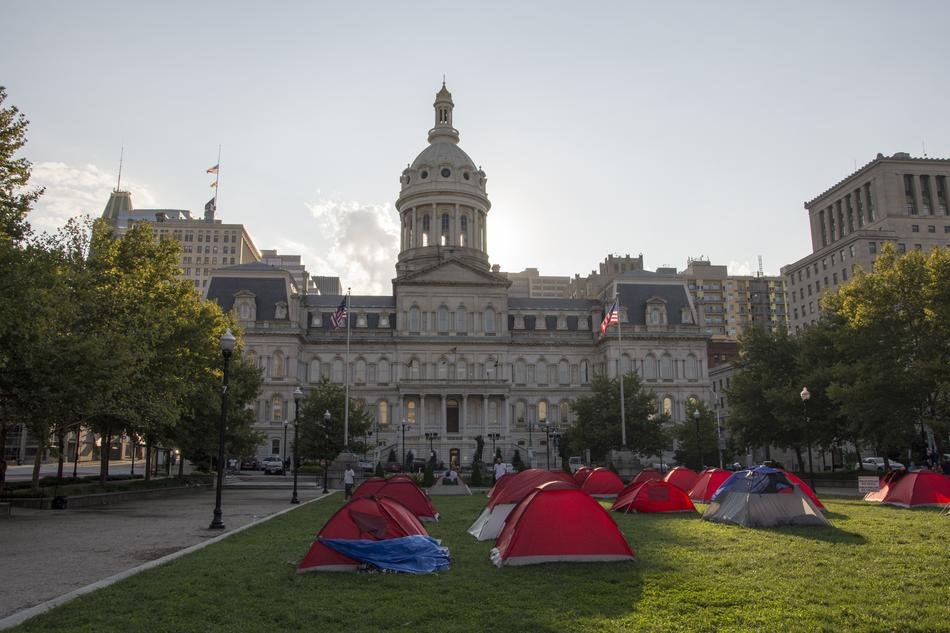
A tent encampment outside Baltimore City Hall in 2017. Photo: Eli Pousson via Pixy.org
Baltimore City’s 2023 Point-in-Time Count Report found that approximately 1,600 residents had no place to call home on a given night, while the city estimated that nearly 5,200 people experienced homelessness over the course of the year. Baltimore is one example of a larger urban homelessness crisis in the United States, as rising housing costs, the destabilizing effects of mass incarceration, and gaps in healthcare have pushed more people into unstable living conditions.
The Scale of the Problem
In 2024, HUD’s Point-in-Time Count found 771,480 people experiencing homelessness nationwide, an 18 percent increase from the previous year and the largest increase since federal Point-in-Time counts began in 2007. The crisis was concentrated heavily in major cities, with New York, Los Angeles, Chicago, Seattle, and Denver accounting for more than one-third of the national total (U.S. News & World Report, 2025). Families with children saw the sharpest increase, rising 39 percent in a single year, while nearly 150,000 children were counted as homeless on one night in January 2024 (HUD, 2024). People experiencing homelessness also die nearly 30 years earlier than the average American, often from treatable illnesses (U.S. Interagency Council on Homelessness [USICH], n.d.).
Affordable Housing Has Not Kept Up The Pace
Cities are beginning to recognize and officially cement the links towards housing and homelessness. For example, the Baltimore City Mayor's Office of Homeless Services (n.d.) identifies the lack of affordable housing as a primary cause of homelessness in the city. Among the 1,551 people counted in the 2023 survey, 19% cited unaffordability as the direct reason for their situation, with eviction at 16% and job loss at 17% closely following (Baltimore City Mayor's Office of Homeless Services [MOHS], 2023). This holds up in national data. In 1970, the United States had a surplus of 300,000 affordable homes; today, only 37 affordable homes are available for every 100 extremely low-income renters, and 70% of the lowest-wage households spend more than half their income on rent (USICH, n.d.). In New York City, 73% of the roughly 820,000 extremely low-income households are severely rent-burdened, spending more than 50% of their income on housing (Coalition for the Homeless, 2025).
Baltimore's experience shows both the possibilities and the limits of targeted investment. In 2022, the city received $75 million through the American Rescue Plan Act and joined HUD's House America initiative, committing to rehouse 1,000 households and add 1,600 affordable units to the pipeline. The city exceeded both targets, rehousing over 1,400 households and adding more than 2,500 units by December 2022 (Smart Cities Dive, 2023). Yet the 2023 Point-in-Time count showed only a modest and statistically inconclusive decline, showing that housing supply investments alone are insufficient when multiple structural causes remain unaddressed (MOHS, 2023).
Incarceration as a Pathway Into Homelessness
The 2023 Baltimore PIT Count found that 41% of people experiencing homelessness had previously been incarcerated (MOHS, 2023). National research from the Prison Policy Initiative found that formerly incarcerated people are nearly ten times more likely to experience homelessness than the general public (Couloute, 2018).Stable housing is often blocked by background checks, security deposits, and landlord policies that disqualify people with convictions. A 2024 study presented to the Maryland General Assembly's Environment and Transportation Committee found that 73% of criminal records in Maryland contain at least one error, higher than the national average of 69%, meaning that screening denials are frequently based on inaccurate information (Maryland General Assembly Environment and Transportation Committee, as cited in Citizen Portal, 2024).
Baltimore bears a disproportionate share of Maryland's incarceration burden. Though the city holds 9% of the state's population, it accounts for 40% of state prison inmates, with over one-third of those coming from just ten neighborhoods (Justice Policy Institute & Prison Policy Initiative, 2022). Black residents make up 62% of Baltimore's population but accounted for 73% of those counted as homeless in 2023 (MOHS, 2023). Nationally, Black Americans accounted for 32% of the homeless population in 2024 despite representing 12% of the U.S. population (HUD, 2024).
When the Evidence Points One Way and Policy Goes Another
At the moment when the evidence calls for sustained federal investment, the policy environment is moving in the opposite direction. In November 2025, HUD issued a sudden change to its Continuum of Care funding rules, capping permanent housing investments at 30% of each jurisdiction's grant. The National Alliance to End Homelessness (2025b) projects that at least 170,000 people nationwide will lose their supportive housing as a result. Cities with the deepest investments in Housing First approaches, including Cleveland, Los Angeles, and New York City, stand to lose thousands of units currently serving older adults, domestic violence survivors, people with disabilities, veterans, and families (Stateline, 2025). The proposed FY2026 federal budget would cut a historic 44% of funding available for HUD's affordable housing and community development programs (National Alliance to End Homelessness [NAEH], 2025c).
What We Already Know, and What We Keep Refusing to Do
At the root of these systemic failures is historical and ongoing racism, from redlining and mass incarceration to inequitable access to healthcare, education, and economic opportunity, which has placed people of color and other historically marginalized groups at disproportionate risk (USICH, n.d.). The decline in veteran homelessness, down 55% since 2009, demonstrates that well-funded, sustained interventions pairing stable housing with wraparound support services produce measurable results (Bipartisan Policy Center, 2024). It followed from a specific federal commitment, maintained over more than a decade, to a defined population with a defined strategy. The structural causes of urban homelessness are well-documented. The interventions that reduce it are well-researched. What remains is applying the policy at the needed scale.
Author Bio: Hira Khan is a Biology major at the University of Maryland, Baltimore County and a Sondheim Public Affairs Scholar committed to public service and policy-driven change.