
Europe Studies | United Kingdom
Article By Jenny Melia
June 22, 2026 12:30 pm EDT
UK Bill to Lower Voting Age to 16 Advances in Parliament
A historic bill to lower the voting age to 16 in the United Kingdom is progressing through Parliament, advancing further in the legislative process than any similar proposal ever before.
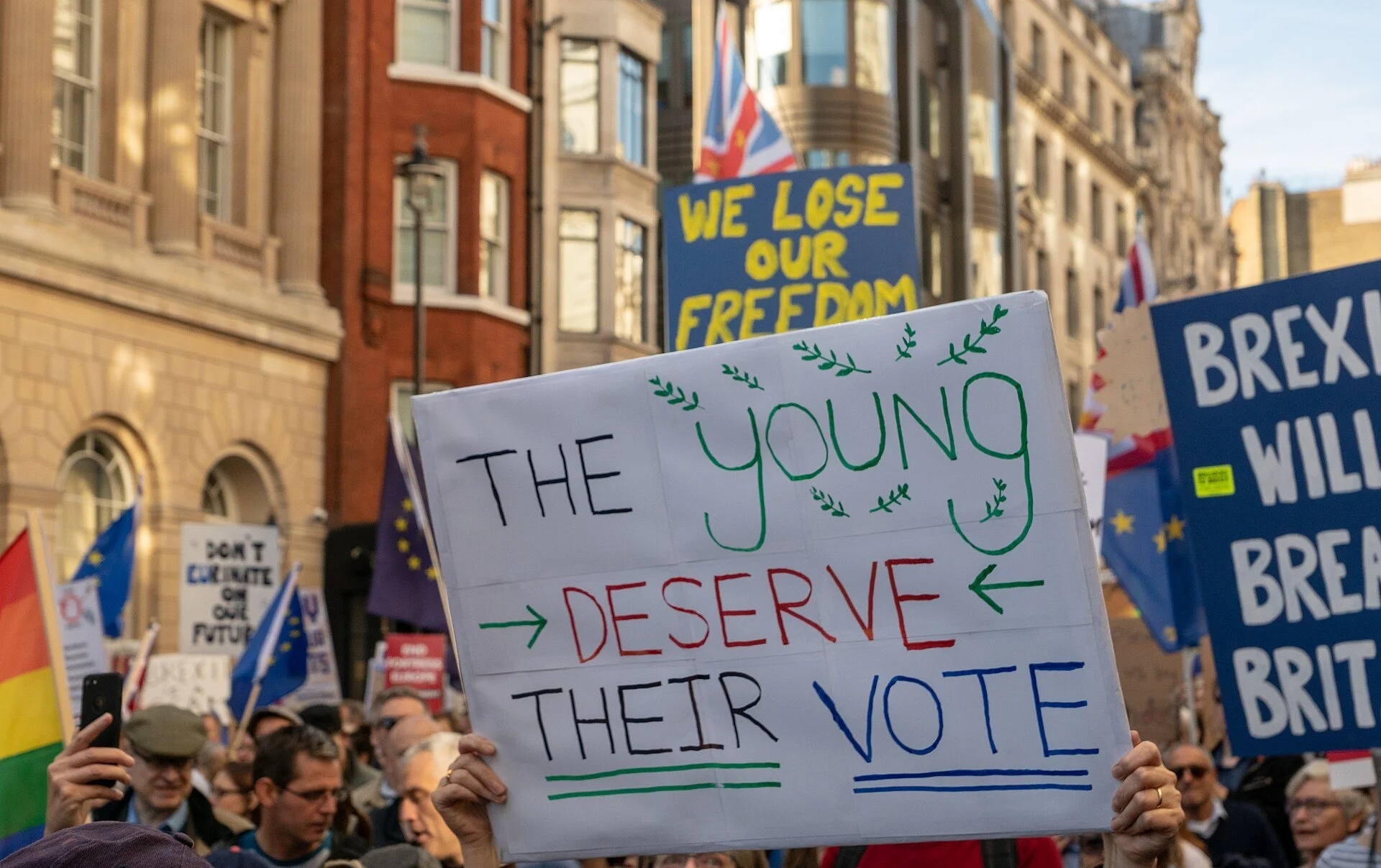
A demonstrator in London holds a sign reading “The young deserve their vote” during the People’s Vote March in 2018. Photo: Colin via Wikimedia Commons
Brought forward by Steve Reed, a Labour MP, the bill aims to ensure young people’s voices are included in the voting process, especially pertaining to national elections. If the bill were to pass, 1.7 million young people (roughly 3% of the population) would be eligible to vote within the UK. Officially titled the Representation of the People Bill, the bill is a package deal making several changes to voting regulations, with the most notable being expanding voter access to 16 and 17-year-olds in England and Northern Ireland. Scotland and Wales have already lowered the voting age for local elections to 16.
The bill was first introduced on February 12, 2026, and later completed second reading and committee stage in the House of Commons. After the 2024–26 parliamentary session ended, the bill was reintroduced on May 14, 2026, and is now awaiting report stage. Although the bill still faces further scrutiny, including report stage, third reading, and consideration in the House of Lords, it has already advanced further than previous parliamentary efforts to lower the voting age to 16.
Earlier Efforts to Lower the Voting Age
The first serious parliamentary attempt to lower the voting age to 16 in the United Kingdom came in 1999, when Simon Hughes, a Liberal Democrat MP, proposed an amendment to the Representation of the People Bill. Speaking in the House of Commons, Hughes argued that 16-year-olds were “old enough to pay their taxes if they work” and contribute to society, but still unable to vote for the politicians who decided how those taxes were spent.
The amendment was defeated in the House of Commons by 434 votes to 36. Nearly a decade later, as youth participation became a more prominent part of the debate over democratic reform, Labour MP Julie Morgan introduced the Voting Age (Reduction) Bill during the 2007–08 parliamentary session. The bill, which sought to lower the voting age to 16 for parliamentary and other elections, was debated at second reading in June 2008 but did not progress further.
A similar effort followed in the 2017–19 Parliament, when Jim McMahon, a Labour MP, introduced the Representation of the People (Young People’s Enfranchisement and Education) Bill, which sought to lower the voting age to 16 and improve political education for young people. The bill was debated at second reading in November 2017 but did not receive a vote, and Peter Kyle, a Labour MP, later introduced a related bill, the Representation of the People (Young People’s Enfranchisement) Bill, which also sought to extend the vote to 16- and 17-year-olds. Kyle’s bill reached second reading in May 2018, but it was not put to a vote after earlier parliamentary business consumed much of the available debating time. While supporters and local reporting described the delay as a filibuster by Conservative opponents, the Deputy Speaker stated in Hansard that no filibustering had taken place under the rules of the House.
Labour’s Push for Votes at 16
Lowering the voting age to 16 was a key Labour Party policy in the 2024 general election, with a section titled “Votes at 16” included in the party’s manifesto. The manifesto stated that Labour would “increase the engagement of young people in our vibrant democracy” by giving 16- and 17-year-olds the right to vote in all elections.
After Labour won 411 seats in the 2024 general election, giving the party a large majority in the House of Commons, it had the numbers to move the issue from a campaign promise into the legislative process. At the second reading of the Representation of the People Bill, a Conservative reasoned amendment opposing the bill was defeated by 410 votes to 105. The vote allowed the bill to continue through Parliament and demonstrated that, unlike earlier attempts to lower the voting age, the proposal now had the backing of a governing majority as well as support from several opposition parties, including the Liberal Democrats, the Scottish National Party, and the Green Party.
Labour MPs also pointed to young people’s own response to the proposal, with Rachel Taylor, the Labour MP for North Warwickshire and Bedworth, noting that students around age 15 or 16 in her constituency had spoken about how much they were looking forward to being able to vote.
Conservative Pushback and Committee Scrutiny
Although the bill cleared second reading with a large majority, Conservative MPs continued to challenge both the timing of the reform and the case for lowering the voting age itself as the bill moved into detailed scrutiny in the Public Bill Committee. Paul Holmes, the Conservative MP for Hamble Valley, questioned whether electoral officials had been given enough time to prepare for the change, while Peter Stanyon of the Association of Electoral Administrators told the committee that there were “some concerns about the timescales” for introducing votes at 16 and 17. The Electoral Commission also warned that adding around 1.7 million new voters would require clear planning, public awareness work, and enough support for electoral administrators.
Holmes further challenged the motive behind the proposal, arguing that Labour supported votes at 16 because it believed younger voters were more likely to support the party. That argument shifted the debate from whether the reform could be delivered in time to whether it was being introduced as a matter of democratic participation or party advantage.
Conservative MPs also questioned whether voting rights should be extended to people still treated as children under other parts of the law. At the second reading of the bill, Sir James Cleverly, a Conservative MP, argued that the Government was either “intending to give votes to children” or trying to redefine 16- and 17-year-olds as “not children,” pointing to the Children Act and the UN Convention on the Rights of the Child as examples of legal frameworks that still define them as children. Paul Holmes, a Conservative MP, made a similar point in committee, asking why Parliament should trust 16-year-olds with “decisions about the future of the nation” if they are not trusted to make decisions about alcohol, finance, or personal safety.
Implications of the Bill for Young People
In the United Kingdom, young people are usually sent their National Insurance number shortly before their 16th birthday, meaning their tax and National Insurance contributions can be recorded if they work. At 16, they can also join the Army with parental consent and are generally entitled to consent to their own medical treatment, while still being unable to vote in UK general elections. For supporters of votes at 16, those responsibilities have become central to the argument that the current voting age excludes young people from decisions that already affect their lives.
MPs made that case during the second reading debate on the Representation of the People Bill, using youth leadership and military service as examples. Florence Eshalomi, the Labour and Co-operative MP for Vauxhall and Camberwell Green, pointed to youth mayor elections and said that “young people have the capacity and knowledge” and “are willing to serve if we give them the opportunity.” Steve Reed, who opened the debate for the Government, argued that if young people can serve in the armed forces, they should also have the right to help choose the government that decides on “matters of war and peace.”
Research on youth voting supports Eshalomi’s point about young people’s “capacity and knowledge,” with the Electoral Commission’s 2026 Youth Tracker, based on a survey of 2,501 young people aged 11 to 25 and four focus groups, finding that young people value democracy and want to participate in it, including 81% who said it is important to live in a democratic country. In Austria, where the voting age was lowered to 16 in 2007, a 2012 study found that voters under 18 were not less motivated or less able to make political choices than older first-time voters. A separate 2017 study using data from Austria’s 2013 parliamentary election and 2015 Viennese regional election found that 16- and 17-year-olds were more likely to vote than older first-time voters.
At the same time, polling released by Children’s Commissioner Dame Rachel de Souza in May 2026 suggests that interest in democracy does not always translate into confidence about voting, with half of 13- to 17-year-olds saying they either did not know which political party they would support in the next general election or whether they would vote at all. The polling focused on 13- to 17-year-olds because many in that age group could be eligible to vote by the next general election if the voting age is lowered to 16. In November 2022, Votes For Schools, a UK platform that collects students’ views through classroom discussions and weekly votes, received 45,313 responses from young people on whether the voting age should be lowered to 16. Among 11- to 16-year-olds, only 45.3% believed everyone should be able to vote at 16. The same classroom vote also found that more than 70% of respondents in the 16+ age group wanted lessons providing balanced information on politics and voting.
For young people, the bill would therefore connect the right to vote with responsibilities they are already allowed to take on at 16. However, polling and student surveys suggest that expanding the vote would need to be matched by stronger civic education, so 16- and 17-year-olds are not only allowed to participate but also prepared to do so with confidence.
What Comes Next?
With the next national election expected within the next three years, the passage of the bill could have a significant effect on British politics. If 1.7 million 16- and 17-year-olds become eligible to vote, political parties would have to think more seriously about how they speak to young people, how young voters are prepared to take part, and how their participation could shape future elections.
As the bill continues through Parliament, debate over votes at 16 is likely to remain focused on both democratic participation and implementation. Supporters see the proposal as a way to bring young people into the electorate earlier, while opponents continue to question whether the reform is being introduced too quickly and whether 16- and 17-year-olds should vote before reaching legal adulthood. Whatever the outcome, the bill has already pushed the issue further through Parliament than previous attempts and placed young people’s role in the UK's democratic system at the center of the national debate.
Author Bio: Jenny Melia is a nonpartisan committee page for the Minnesota House of Representatives. She holds a Bachelor of Science with High Distinction in Sociology of Law, Crime, and Justice from the University of Minnesota.