
Africa Studies | Kenya
Article By Efrata Eshetu
June 18, 2026 7:00 pm EDT
Kenya’s Gen-Z Protests and State-Sponsored Repression
A historic bill to lower the voting age to 16 in the United Kingdom is progressing through Parliament, advancing further in the legislative process than any similar proposal ever before.
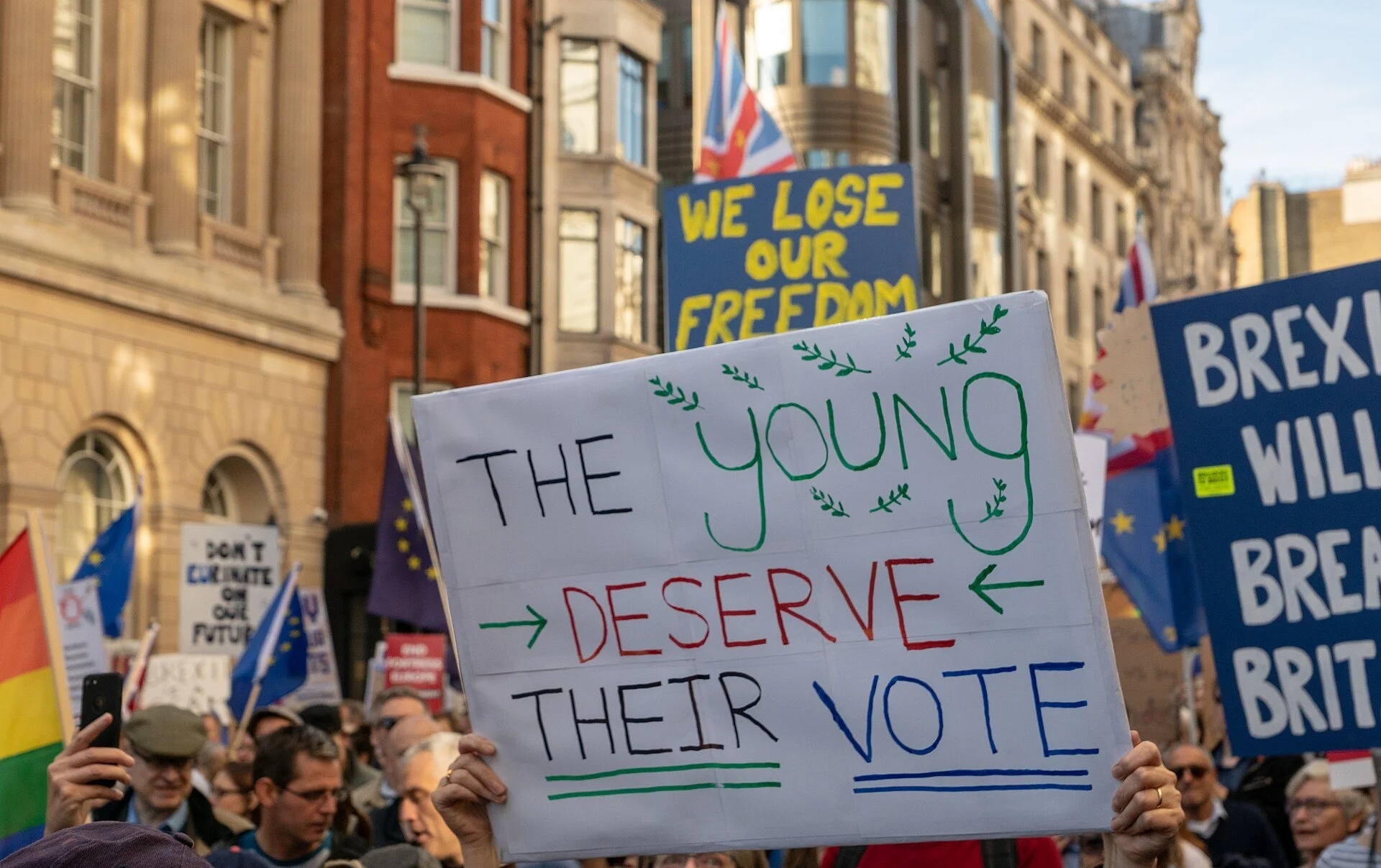
A demonstrator in London holds a sign reading “The young deserve their vote” during the People’s Vote March in 2018. Photo: Colin via Wikimedia Commons
On June 8, 2025, microblogger Albert Ojwang died in police custody shortly after criticizing a senior police officer on X, formerly Twitter. His death helped trigger Kenya’s 2025 Gen Z protests by turning long-standing anger over government accountability into mass mobilization. As demonstrations spread, social media became both an organizing tool and a source of information for young Kenyans.
During the 2024 Finance Bill protests, hashtags such as #OccupyParliament and #RejectFinanceBill helped users share information, coordinate demonstrations, and draw wider attention to the movement. After Ojwang’s death in 2025, social media again became central as users documented police conduct, circulated protest updates, and demanded accountability. However, the same social media platforms that helped young Kenyans organize and share information also allowed authorities to monitor, intimidate, and suppress dissent through surveillance, online harassment, targeted arrests, and disappearances.
How Social Media Helped Organize Kenya’s Gen Z Protests
According to the Media Council of Kenya, the June 2024 protests were planned and carried out mainly through social media platforms such as X and TikTok, where users explained the Finance Bill, followed protest updates, and mobilized around the demonstrations. Instead of moving through party structures or formal opposition leaders, information spread through online conversations as young Kenyans debated the bill, criticized the government’s response, and urged others to join the demonstrations.
On X, formerly Twitter, Eric, the user behind the account @amerix, hosted “The Citizen’s Assembly,” an X Spaces forum where users discussed the Finance Bill and the government’s response to protesters. Held on July 7 and July 14, 2024, the forum drew about 60,000 listeners, according to the Media Council of Kenya. As the protests unfolded, X Spaces gave users a way to debate the bill, respond to arrests, and call for accountability in real time.
On TikTok, videos and livestreams gave users a direct view of the demonstrations as they unfolded, allowing many Kenyans to follow footage from the ground rather than relying only on official government statements. The footage captured scenes of confrontation and police misconduct, while its circulation helped preserve a record of events as they happened. After nationwide internet restrictions were reported during the June 2024 protests, users began sharing instructions for downloading and using VPNs so they could stay connected.
After Albert Ojwang died in police custody in June 2025, Kenyans again used social media to follow the protests as footage from the ground circulated online. Reuters reported that Ojwang had been arrested after allegedly defaming Deputy Inspector General Eliud Lagat online, and protesters later demanded Lagat’s resignation during demonstrations in Nairobi. During the June 17 protests, footage shared on X showed police striking Boniface Kariuki, a street vendor, before one officer shot him at close range. Kariuki later died from his injuries, according to his family.
Kenyan Authorities’ Social Media Surveillance and Crackdown
As young Kenyans used social media to organize and document the protests, their online activity also made them easier for authorities to identify, monitor, and intimidate. Amnesty International reported that Kenyan authorities deployed social media and digital tools to suppress Gen Z-led protests between June 2024 and July 2025, with young activists facing online threats, smear campaigns, surveillance, arrests, enforced disappearances, and killings.
During the 2024 Finance Bill protests, Amnesty documented cases such as Mariam, a Mombasa-based human rights defender whose name was changed for safety reasons, who received death threats online before police detained her for two nights. Another activist, identified as Joseph, said he received a direct message on X warning, “We are coming for you.”
Amnesty documented coordinated pro-government posting on X through John, a pseudonym for a young man who said he ran paid online campaigns for political and commercial clients, including government figures. He told Amnesty that his network used WhatsApp to organize about 20 people, with each person running several accounts to push pro-government messages to Kenyans on X. During large protests, the network created counter-campaigns in response to protest hashtags; for example, John said they answered #RutoMustGo with #RutoMustGoOn.
After Albert Ojwang’s death in police custody in 2025, coordinated posts again targeted protest messages online. Amnesty reported that posts under #endpolicebrutalityke were countered by accounts repeating “I Appreciate Police,” which reached Kenya’s top ten trends on X for several hours. On June 24, 2025, another campaign used #ChaosCartel to claim that Amnesty International was funding protest logistics, while a July 2025 AI-generated video circulated on TikTok and X with allegations of a conspiracy involving activists, civil society groups, international journalists, and Senator Okiya Omtatah.
Digital Blackouts and Broadcast Restrictions During the Protests
As the Finance Bill protests grew in June 2024, civil society groups warned the government against restricting internet access during demonstrations. On June 24, the Communications Authority of Kenya said it had no intention of shutting down the internet, but the next day Access Now, a digital rights organization, reported that internet connectivity had dropped nationwide by nearly 40 percent across at least 20 networks. ARTICLE 19, a free expression group, described the outage as a nationwide restriction on internet access during the protests.
Internet connectivity dropped during the June 25 demonstrations, and the cause of the outage remained unclear. The Internet Society, a nonprofit that studies internet infrastructure, later said the seven-hour disruption may have involved critical internet infrastructure, while ARTICLE 19 questioned why it happened during the peak of the protests. For protesters who depended on X, TikTok, livestreams, and messaging platforms to follow events, even a temporary internet outage made it harder to communicate, verify information, and document police conduct as demonstrations unfolded.
During the June 25 protests, the Communications Authority ordered television and radio stations to stop live broadcasts and warned that continued coverage could lead to regulatory action. Several broadcasters, including NTV, KTN, K24, and Kameme, were later taken off air. KTN said it continued broadcasting on YouTube, Facebook, and X, while a senior official at Nation Media Group, which owns NTV, told Reuters that NTV was live only on YouTube and its website. The Washington Center for Human Rights described the live broadcast ban and internet restrictions as violations of several protections in Kenya’s Constitution, including freedom of expression under Article 33, freedom of the media under Article 34, access to information under Article 35, freedom of association under Article 36, and peaceful assembly under Article 37.
For young Kenyans who had used social media to organize, livestream demonstrations, and share footage of police conduct, internet outages and broadcast restrictions made it harder to follow updates and watch live coverage in real time. By interrupting internet access and threatening broadcasters, Kenyan authorities narrowed the channels young Kenyans used to document and participate in the demonstrations.
Targeted Arrests, Disappearances, and Online Attacks of Protesters
Amnesty International recorded that the 2024 and 2025 protests resulted in 128 deaths, 3,000 arrests, and over 83 disappearances prompted by excessive use of force. Human rights defenders have been government targets on social media platforms, best illustrated by Mariam *, a defender who received digital death threats and was forcibly disappeared by the police for two nights in 2024. The transition from online harassment to physical abduction demonstrates how digital monitoring and targeting directly enables state-wide sponsored violence. Albert Ojwang’s case was a culmination of surveillance and targeted arrest. Under the alias “Pixel Pioneer,” which amassed over 13,000 followers, one of his online claims accused Deputy Inspector General Eliud Lagat of corruption, citing that he deployed trusted allies to oversee desks at the Directorate of Criminal Investigations (DCI), Occurrence Book (OB) entries, and traffic shifts, to control intel. Despite operating under a pseudonym, authorities tracked his digital footprints, detaining him on June 7th, 2025. The unmasking and arresting of online influencers like Albert Ojwang demonstrate that anonymity is an illusion, proving that digital footprints can be lethal.
Psychological Impact of Online Suppression and Threats of Users
The weight of online smear campaigns and physical violence by the Kenyan government has introduced a “spiral of silence” in the online community. Coined by Elisabeth Noelle-Neumann, this theory centralizes one’s fear of social isolation, suppressing their opinions for fear of public rejection or backlash. This circulation of fear, as documented by The Africa Report, has led to many Kenyans being afraid of arrest and abduction if they openly criticise the government. For instance, Serah, a human rights defender, stated she deleted all protest photos and messages on her social media accounts after receiving anonymous threats warning her to stop. The fear of future retaliation has stifled the future political participation of youth, with a university student from Nairobi, Loba, believing government agents were intimidating him online, threatening the end of his studies if he persisted with protesting. One of the threats he received stated, “You are protesting against the government that pays your university fees. Consider it the end of your studies.” With his education threatened, he is unsure if he would participate in future youth protests. This internal censorship is evident of how impactful the government’s online suppressive tactics are in conditioning Kenyans to silence themselves in fear of retaliation
The Weaponization of the Computer Misuse and Cybercrimes Act
A pivotal moment in social media security occurred on June 23, 2025, when Joshua Okayo, President of the Kenya School of Law, filed a petition to amend the Computer Misuse and Cybercrimes Act following the recent youth-led social media uprisings. It aimed to repeal Sections 22 and 23, which criminalise the misinformation and publication of false or misleading information. The petition was later codified by President Ruto on October 15, 2025, and has since faced nation-wide scrutiny. While the government argues this law aims to combat cyber crimes, defamation, and other wrongful practices, civil rights groups believe it could impede freedom of speech and expression. The surveillance and misuse of social media by government authorities inhibit Kenyans from practicing freedom of speech, a right protected by the Kenyan Constitution and international laws.
The Limits of Digital-Censorship: Gen Z’s Counter-Defense
Ultimately, the transition of social media from an environment for democratic engagement to state-sponsored suppression represents a regression of democratic values in Kenya. While the government has succeeded in implementing state-wide surveillance and violence through the 2024 Amendment Act and the death of online influencers such as Albert Ojwang, the control is being contested by the Kenya Human Rights Commission (KHRC). They claimed that the 2024 Amendment undermines the Data Protection Act of 2019 and violates the National Constitution. The Kenyan government has only achieved surface-level suppression, as online users can resort to VPNs, representing an act of digital resistance and failure of total state control. By transforming social media as a digital archive of state intrusion, Gen Z has ensured that evidence of police brutality and targeted attacks would not be erased. Through this, they are able to expose the fragmented state-wide censorship and continue to demand accountability.
Author Bio: Jenny Melia is a nonpartisan committee page for the Minnesota House of Representatives. She holds a Bachelor of Science with High Distinction in Sociology of Law, Crime, and Justice from the University of Minnesota.