United States | Criminal Justice Reform
Article By Madeline Huang
November 24, 2026 12:18 pm EST
Mayor Mamdani Announces Disbandment of NYPD Unit Involved in the 2020 Black Lives Matter Protest Response
The decision follows years of criticism over the unit’s handling of protests and fulfills a key campaign promise.
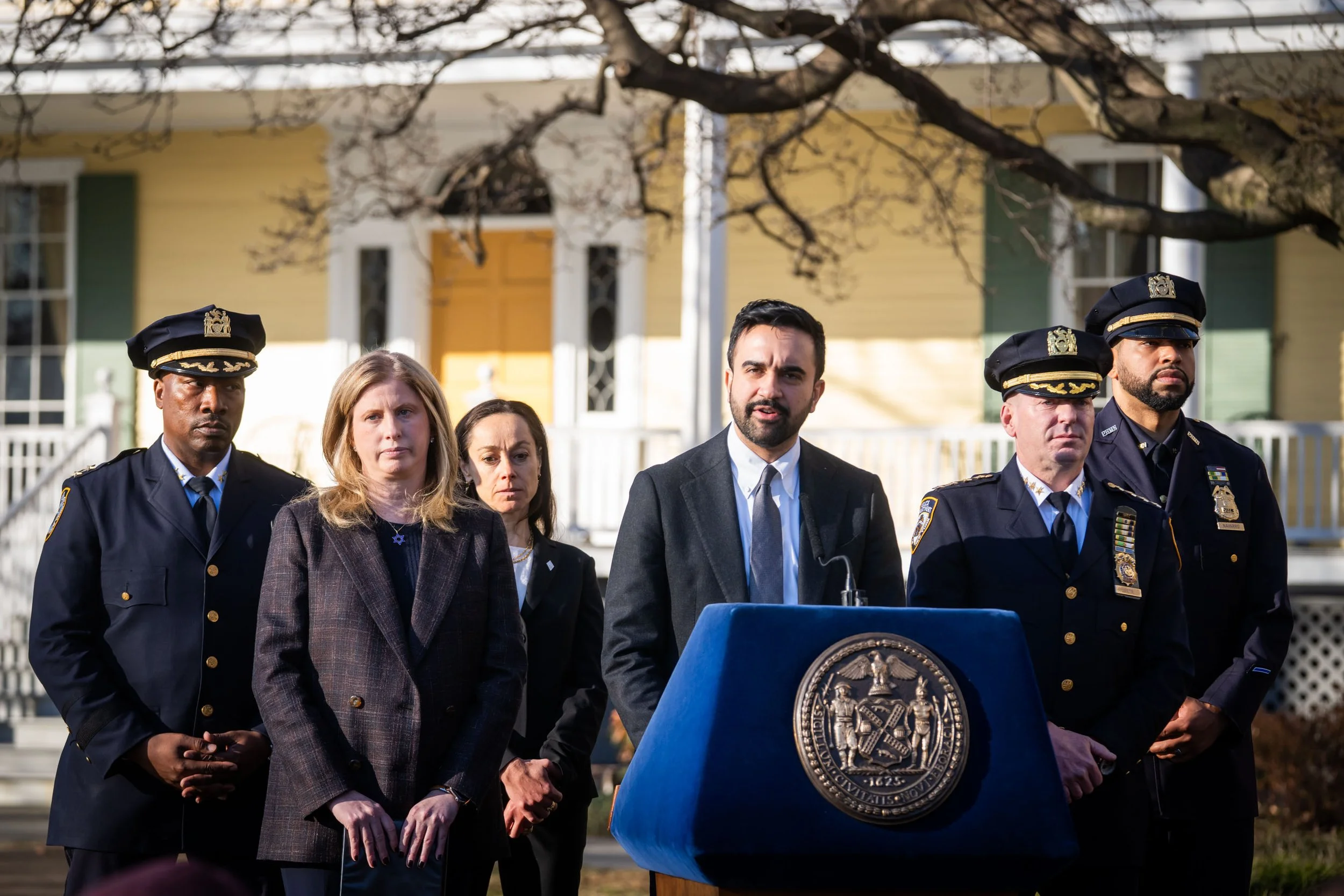
Mayor Mamdani holds a press conference at Gracie Mansion with NYPD Commissioner Jessica S. Tisch. Monday, March 9, 2026. Credit: Ed Reed/Mayoral Photography Office.
In a momentous decision on Monday, November 16, Mayor Mamdani announced the disbandment of the controversial Strategic Response Group (SRG) of the New York Police Department. As part of the restructuring, the mayor outlined plans to create the civilian-led Community Dialogue and De-Escalation Division (CDDD), which will operate without weapons or arrest powers and work directly with the newly created First Amendment Support Team (FAST) within the NYPD.
Mamdani’s decision comes after years of backlash over the SRG’s handling of civilian protests. In fact, during his 2025 mayoral campaign, Mamdani actually promised New Yorkers that his administration would work to disband the SRG and “separate counterterrorism from protest response”. Now, his administration is following through on that promise by introducing new restrictions on the use of force and banning controversial police tactics during protests.
What Is the Strategic Response Group?
The NYPD’s SRG unit was originally created in 2015 for counterterrorism purposes. However, over the years, its scope has expanded to include responding to protests, which has attracted criticism from local civil rights groups such as the New York Civil Liberties Union and the Legal Defense Fund over allegations of excessive use of force. In particular, the deployment of SRG units during the Black Lives Matter (BLM) demonstrations in 2020 generated massive backlash over their use of weapons and crowd-control tactics such as pepper spray and “kettling”, a method in which police surround a group of people and contain them in a restricted area, blocking and controlling their exit points.
One of the worst examples of these abuses occurred in Mott Haven, the Bronx, on June 4, 2020, when SRG officers and other NYPD units surrounded protesters shortly before the city's 8 p.m. curfew. The SRG officers blocked the protesters’ path while other NYPD officers closed in from behind, leaving them with no way to disperse. The officers then used batons and pepper spray against protesters and arrested more than 250 people. The incident later resulted in a 2023 settlement under which New York City agreed to pay $21,500 to each eligible protester who had been arrested or subjected to police abuse.
Shortly after the 2020 BLM protests, the City’s Department of Investigation (DOI) released an investigative report in December 2020 that found the NYPD and the SRG units used excessive force and failed to adequately protect demonstrators’ First Amendment rights in responding to protests. In regard to the Mott Haven incident specifically, the report stated that “the force required to carry out a mass arrest was disproportionate to the identified threat.” The investigative report concluded that the NYPD methods intended to maintain public safety often had the opposite effect because they promoted more confrontations between police and protesters rather than de-escalating tensions.
Mamdani’s Plan to Restructure the NYPD
Along with the disbandment of the SRG, Mamdani’s plan also focuses on banning protest-response tactics identified in the DOI’s report. These restrictions include a ban on kettling, long guns, and the use of tear gas during protests. Additionally, police officers will no longer be permitted to use pepper spray to control crowds during protests, and long-range acoustic devices will be limited to 90 decibels. Finally, officers will be prohibited from using bicycles as weapons except when necessary to prevent death or physical injury to themselves or another person.
Mayor Mamdani’s plan to disband the SRG will consolidate its original counterterrorism functions, including the deployment of heavily armed officers to protect critical infrastructure, within the NYPD’s Intelligence and Counterterrorism Bureau. The move is intended to separate the NYPD’s response to terrorist threats from its handling of public demonstrations, a distinction Mamdani argued was necessary to protect New Yorkers’ constitutional right to protest.
“New Yorkers exercising their constitutional right to protest should not be met with the same police response as a terrorism threat,” Mamdani said during a press conference on November 17.
The mayor credited Councilmember Chi Ossé’s Communities United to Reject Brutality (CURB) Act for proposing many of the changes announced by his administration, including restrictions on police tactics during protests. He endorsed the bill, which would make those restrictions part of city law and prevent future administrations from easily reversing them.
The disbandment of the SRG will lead to the creation of a new patrol unit called the Patrol Support Division, which will report to the Patrol Services Bureau. The new unit will be composed of vetted officers with specialized protest-response training and will work with the CDDD and FAST during demonstrations. Officers in the division will retain the authority to make arrests at these demonstrations when necessary.
Police Commissioner Jessica Tisch expressed her support for the disbandment of the SRG but said the NYPD must retain the resources necessary to protect the public and respond to serious threats.
“I would never support changes that diminish the NYPD’s ability to protect New Yorkers, or that put our officers in a position where they lack the resources necessary to confront a serious threat,” Tisch said.
Reactions to the SRG’s Disbandment
The New York Civil Liberties Union (NYCLU) had spent years documenting allegations of excessive force by the SRG and calling for its disbandment. Following Mamdani’s announcement on Monday, the organization’s executive director, Donna Lieberman, declared that “the thug unit has been disbanded.”
The Democratic Socialists of America joined 44 other organizations in a joint statement issued by the CURB Coalition welcoming Mamdani’s decision to disband the SRG.
But not every organization that supports the SRG’s disbandment is satisfied with Mamdani’s plan. The Justice Committee, one of the organizations that signed the CURB Coalition’s joint statement, questioned whether the new Patrol Support Division would simply replace the SRG under a different name. Its executive director, Loyda Colón, cautioned in a statement released on November 16 that disbanding the SRG could amount to nothing more than “rebranding and reshuffling SRG officers and functions.”
On the other hand, police union leaders such as Scott Munro, president of the Detectives’ Endowment Association, opposed the dissolution of the SRG. Munro argued that reducing the NYPD’s crowd-control capabilities could force detectives to leave criminal investigations to police protests. Another critic of the mayor’s plan, Vincent Vallelong, president of the Sergeants Benevolent Association (SBA), the union representing NYPD sergeants, argued that disbanding the SRG could leave officers and protesters vulnerable to violence during demonstrations. Vallelong cited the March 7, 2026, attempted bombing during opposing demonstrations outside Gracie Mansion, where two men were later charged with attempting to detonate explosive devices, as an example of the dangers officers and protesters could face during demonstrations.
Despite the mixed reactions to Mamdani’s decision, the NYPD is expected to begin disbanding the SRG in February 2027, with the transition scheduled for completion by spring 2027. The new unarmed civilian unit is not expected to be operational until 2028.
Author Bio: Madeline Huang is a sophomore at Barnard College of Columbia University, pursuing a double major in political science and psychology. Her research and analysis focus on pressing issues affecting young Americans and how those issues influence social attitudes.
Read More
Lula and Bolsonaro Advance to Runoff in Brazil's Presidential Election
October 26, 2026
By Veronica Martin
Opportunity Gap: Why Young Educated Nigerians Are Turning to Cybercrime
October 8, 2026
By Patrick Slover