United States | Artificial Intelligence
Article By Nikki Liu
September 24, 2026 10:48 am EDT
Project Jupiter and the Cost of AI's Water Footprint in the Desert
A massive AI data center project less than 10 miles from El Paso is forcing residents and county officials to confront the tradeoffs between economic growth, water scarcity, and environmental risks.
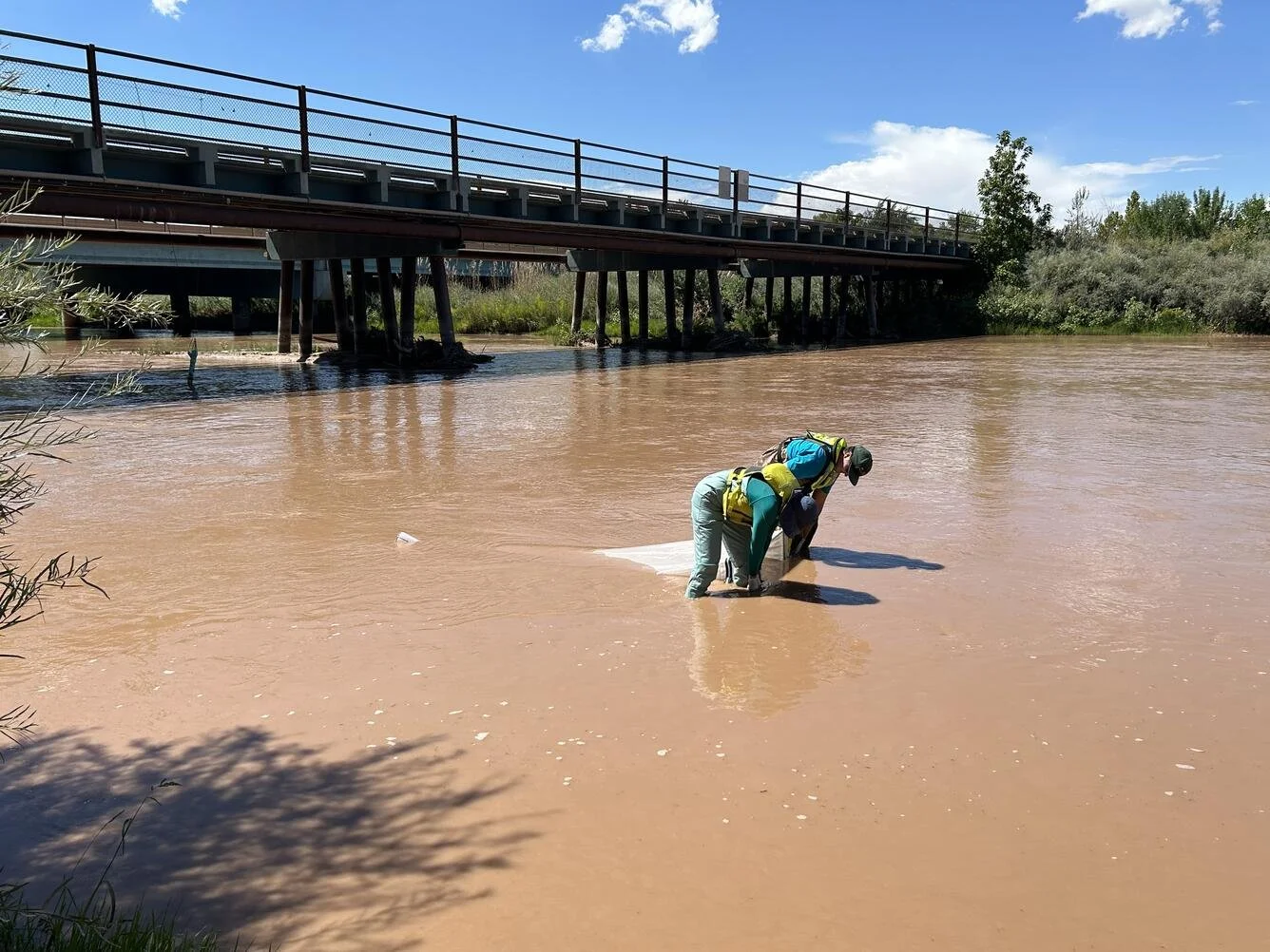
USGS hydrologists conducting microplastics sampling using the “in-stream net” method in the Rio Grande. Photo credit: Public domain.
Artificial intelligence has become a major focus for technology companies around the world. In recent years, the industry has invested heavily in developing more powerful models and expanding the infrastructure needed to support them. Meta alone expects to spend between $130 billion and $145 billion on capital expenditures in 2026, much of it tied to infrastructure needed to support its AI ambitions. According to Gartner, worldwide spending on AI is now forecast to reach $2.7 trillion in 2026, a 49.5 percent increase from 2025. More than half of that spending is expected to go toward AI infrastructure, which Gartner forecasts will account for about $1.48 trillion this year.
One of the largest AI infrastructure projects now under development in the United States is Project Jupiter, a data center campus near Santa Teresa in Doña Ana County, New Mexico. The Doña Ana County Board of County Commissioners has authorized up to $165 billion in Industrial Revenue Bonds for Project Jupiter. This is the maximum amount that Red Chiles A, B, C, and D, LLC, and Yucca Growth Infrastructure, LLC, collectively the companies developing the project, could invest over the 30-year financing term. Under the agreement, at least $50 billion must be invested within the first five years. The roughly 1,400 acres campus is expected to include four data center buildings along with the power and other infrastructure needed to operate them. The size of Project Jupiter has raised concerns among more than 300 Doña Ana County residents who attended an August legislative listening session, where residents questioned the project’s water use, air quality, energy demand, and economic effects. The session was convened by four Democratic state senators from Las Cruces: Joseph Cervantes, Carrie Hamblen, Bill Soules, and Jeff Steinborn. State Sen. Hamblen said the county’s use of a nondisclosure agreement (NDA) was what first raised concerns for her about the project. “I can see why the county looked at this project as something that would fix a lot of things that they are struggling to try and repair,” Hamblen said. “But when the NDA came into play is when I started having red flags, because when you are signing an NDA, it’s because you don’t want information out there,” she continued.
One of the residents who spoke at the session, Taylor Axtell, called for an investigation into the project and the officials involved. “We want our county commissioners investigated,” Axtell said. “They need to be held accountable.” Another resident, Iliana Perez, said she hoped state senators would listen to the community because, in her words, “the County didn’t.”
The project’s water demand is also concerning for residents and state officials because the campus is being built in the Lower Rio Grande basin, where New Mexico is legally required to reduce groundwater depletion under a settlement between New Mexico, Texas, and Colorado that the U.S. Supreme Court approved on May 26, 2026. The case stemmed from Texas’s claim that groundwater pumping in southern New Mexico was reducing the amount of Rio Grande water reaching the state downstream. Under the settlement, New Mexico must reduce groundwater pumping in the Lower Rio Grande basin, acquire water rights from existing users, and permanently retire thousands of acres of irrigated farmland.
Project Jupiter’s promised economic benefits could have a significant impact in Doña Ana County because 17.9% of residents there live below the poverty line, and the project plans to provide $360 million in direct support for infrastructure, schools, and local services across the county; this is in addition to the $50 million it would devote to improving local water systems, which have been struggling due to the dry climate. Another $6.9 million is expected to be allocated for education, habitat restoration, and workforce development.
On September 8, Oracle said Project Jupiter was on pace to create more than 7,000 construction jobs and support 1,500 ongoing project-supported jobs once construction is complete. Full-time salaries for those jobs are expected to average between $75,000 and $100,000, which would place them above Doña Ana County’s median household income of $56,800 from 2020 to 2024. Oracle said the project would prioritize hiring and training Doña Ana County residents to fill those jobs, and that nearly 1,000 New Mexico residents were already onsite as construction moved forward. However, the extent to which these investments and jobs will produce lasting economic benefits for Doña Ana County will only become clear with time, since this is a project unlike any before.
Despite the economic benefits Project Jupiter promises to bring to Doña Ana County, the project could also carry significant environmental costs because of the amount of energy it will require and the uncertainty surrounding its water use. Some of the funding promised for local water systems could help address existing problems, including arsenic violations reported in 2023 after equipment at a local water utility stopped properly treating arsenic in groundwater. But what good is cleaner water for a community if the project creates other environmental problems for the people who live there? In fact, Project Jupiter could worsen some of the environmental pressures New Mexico is already facing because its projected demand for water would add to concerns in a state where drought and a dry climate have already placed pressure on limited water supplies. The project is also forecasted to produce millions of tons of greenhouse gas emissions each year, which could add to the state’s air pollution and contribute further to climate change.
The original plan for Project Jupiter, filed with the New Mexico Environment Department, relied on gas turbines and diesel generators and was projected to produce more than 14 million metric tons of greenhouse gases per year. After residents and local leaders raised concerns about the project’s air quality and environmental impact, the developers revised the power plan and replaced the original system with a fuel-cell microgrid. The change lowered the project’s estimated greenhouse gas emissions to about 10.1 million metric tons annually. Even with that reduction, the project would still produce more greenhouse gas emissions each year than Albuquerque and Las Cruces combined; the two cities emit about 6.7 million metric tons annually. The fuel-cell system would still rely on natural gas to generate electricity for the data center, so the project would continue to produce substantial greenhouse gas emissions.
Project Jupiter is being built near Santa Teresa, New Mexico, where about 5,000 people live, and is less than 10 miles from El Paso, Texas, a city with about 683,000 residents. And because the project’s fuel-cell system would still rely on natural gas, these nearby communities could face increased exposure to air pollution produced by the project for years to come.
In addition to the potential increase in air pollution in the communities surrounding Project Jupiter, the project might also consume a significant amount of water in a state where supplies are already under serious strain. For example, in April 2026, the U.S. Bureau of Reclamation reported that New Mexico was entering a third consecutive dry year, with one of the lowest snowpacks on record and most reservoirs along the Rio Chama and Rio Grande holding less than 15 percent of their capacity. And in May, Gov. Michelle Lujan Grisham declared a statewide drought emergency after historically low snowpack and record-high spring temperatures contributed to record-low runoff and below-average river flows across the state.
Before Oracle settled on the current design for Project Jupiter, the estimated water needs for the project were expected to be much higher than the estimates the company provides today. But the revised plan replaced the original gas-turbine and diesel-generator system with a fuel-cell microgrid and a closed-loop cooling system that repeatedly reuses the same cooling liquid. Still, each of the four data center buildings would still require about 2.5 million gallons of nonpotable water for its initial fill, while the fuel-cell system would require another 960,000 gallons at startup. After that, Oracle says the cooling system would need little to no additional water during normal operations and the fuel cells would use water mainly during maintenance. But questions still remain about how much water the fully built campus would require once it starts operating at full capacity. And part of that skepticism comes from how quickly the project moved through the approval process and how much its water and power plans have changed since it became public.
Project Jupiter was only publicly disclosed about a month before the Doña Ana County Commission voted on it; this gave residents little time to actually examine the project before it was approved. KVIA, a local news outlet in El Paso, reported that Commissioner Susana Chaparro said she had not learned about Project Jupiter until August 2025, even though the project had been introduced at the state level months earlier. Chaparro asked the commission to delay the vote by 30 days so she could ask more questions and consult with her constituents, but the request was rejected and the commission approved the project’s Industrial Revenue Bonds on September 19, 2025.
Doña Ana County and New Mexico are giving Project Jupiter major public incentives because the project promises jobs and investment. But those benefits depend on a rapidly expanding AI market whose long-term returns are still uncertain. And if the economics of AI infrastructure change, meaning the unprecedented surge in AI investment we are seeing starts to decline, these communities could be left with fewer benefits than originally promised.
If Project Jupiter ends up not becoming as profitable as its investors expect, what would happen to the workers hired to support it? Would the community still receive the financial support it was promised? And more importantly, who would be responsible for the health and environmental costs the project could impose on local residents and the surrounding community?
Author Bio: Nikki Liu is a John Martinson Honors Program student at Northeastern University pursuing a degree in Politics, Philosophy, and Economics. As a research assistant on a project led by Dr. Sarah Lageson, in collaboration with Bay Area Legal Aid and The Access Project, she has examined access to criminal record expungement in California, working to advocate for those facing legal and economic barriers after their sentence.
Read More

Nearly A Million Young People In The UK Are Not in Education, Training, or Employment
September 7, 2026
By Jenny Melia

Oprah Winfrey’s South African Girls’ Academy to End Operations in 2027
August 5, 2026
By Zachary Burden