Article By Veronica Martin
October 6, 2026 12:05 pm EDT
Lula Wins Brazil’s Presidential Runoff as Bolsonaro Rejects Election Results
Lula secured a historic fourth term in a comeback victory over Bolsonaro, who is challenging the results over a controversial extension of voting hours.
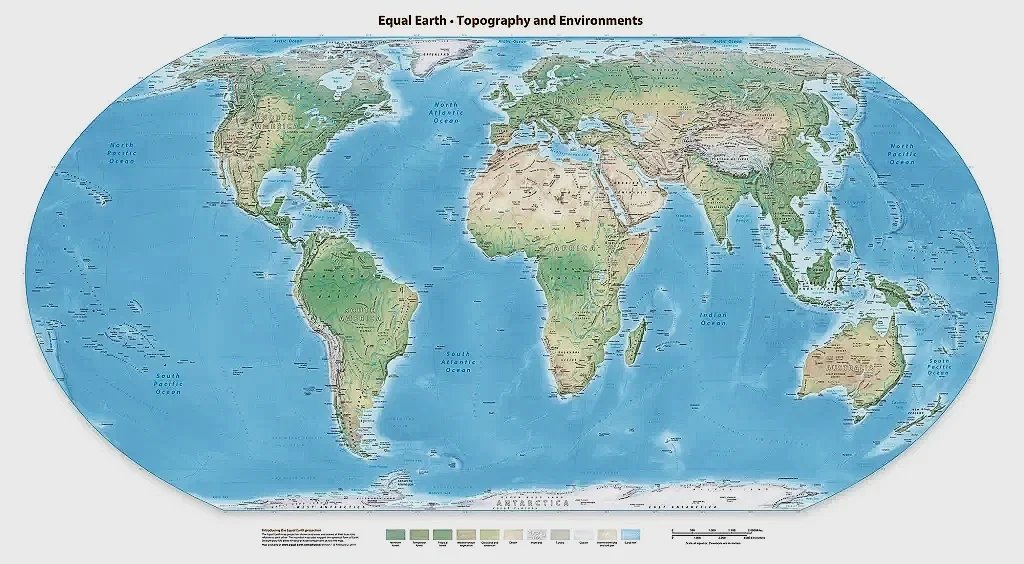
The Equal Earth projection preserves the relative area of continents and landmasses and is one of the equal-area projections promoted by the United Nations’ “Correct the Map” resolution. Map credit: Tom Patterson/Equal-Earth.com
Incumbent President Lula da Silva won Brazil’s October 25 presidential runoff, securing 51.79 percent of valid votes to right-wing challenger Flávio Bolsonaro’s 48.21 percent. The victory marks a historic political comeback for Lula, who trailed Bolsonaro in the October 4 first round by nearly two percentage points, and secured his fourth nonconsecutive presidential term.
Lula’s victory has been overshadowed by controversy surrounding a last-minute judicial decision to extend voting hours by two hours following transportation disruptions and severe weather. Zanin previously served as Lula’s lawyer before his appointment to the Supreme Court in 2023.
Bolsonaro has refused to concede defeat and announced plans to seek the annulment of the election results. He called the decision “unacceptable” and accused Supreme Court Justice Cristiano Zanin of changing “the rules of the game in the middle of the game.”
Brazil is the third country in Latin America to hold a presidential runoff this year, following Peru and Colombia, which held theirs in June.
About the Candidates
Luiz Inácio Lula da Silva is the co-founder of Brazil’s Workers’ Party (PT) and the leftist incumbent president. During his reelection campaign, Lula pursued what Reuters described in September as one of the most anodyne campaigns in years amid concerns about misinformation and foreign interference.
Lula made his first bid for the presidency in 1989 after Brazil’s return to democracy, but only won after his fourth attempt in 2002. In Brazil, presidents may serve two consecutive terms and return to office after sitting out at least one term; thus, after winning reelection in 2006 and then being barred from running in 2018 because of a corruption conviction that was later overturned, Lula was reelected again in 2022.
Lula left office after his second term in 2010 with an approval rating of 80 percent, and an estimated 40 million Brazilians had been lifted out of poverty during his presidency. Moreover, the country benefited from a significant commodity boom. During Lula’s third term in office, Brazil recorded a decline in unemployment to a record low of 5.6 percent in 2025, while the economy grew by 2.3 percent the same year, though voters remain concerned about rising living costs.
Lula made labor reform a central part of his reelection campaign, particularly pushing for a reduction in Brazil’s maximum workweek from 44 to 40 hours without cutting workers’ pay. And on October 14, Congress formally approved a constitutional amendment implementing the proposed reduction, just nine days before the presidential runoff. The amendment received support from lawmakers across the political spectrum, including Flávio Bolsonaro, who reversed his earlier opposition and voted in favor.
As in his 2022 campaign, Lula placed greater emphasis on Brazilian sovereignty in this election cycle, a strategy that builds on the political momentum he gained in 2025 after opposing President Donald Trump’s 40 percent tariffs on Brazilian goods, which took effect on August 6, 2025. His defense of Brazilian sovereignty was among the factors associated with an 8-percentage-point increase in his approval rating between May and October that year.
With the Trump administration imposing new 25 percent tariffs on certain Brazilian goods in July 2026, Lula once again leveraged his tried-and-true calls for sovereignty in his reelection campaign. However, despite these efforts, Lula’s disapproval rating climbed to 50 percent in September amid concerns among voters about the rising cost of living.
On the other hand, Flávio Bolsonaro, the Liberal Party candidate, son of former President Jair Bolsonaro, and Lula’s right-leaning opponent, ran on a hardline security agenda, including proposals to build maximum-security prisons and increase penalties for serious crimes. Bolsonaro also promised to expand investment in Brazil’s energy and critical mineral sectors, including establishing long-term strategic partnerships with the United States to develop Brazil’s critical minerals, a move that reflects his alignment with the Trump administration’s recent push to secure access to energy and mineral resources across Latin America.
Bolsonaro campaigned on the promise of establishing a new constitutional fiscal framework that he had hoped to secure congressional approval for if elected. The proposed framework would tie spending restrictions to Brazil’s debt-to-GDP ratio. However, a similar spending framework was approved in 2016, but gradually lost credibility as successive governments, including that of former President Jair Bolsonaro, found ways to bypass its spending restrictions.
Bolsonaro's campaign did not explain how his proposed framework would prevent the spending restrictions from being bypassed as they were under the previous cap.
Although Bolsonaro initially struggled to secure support from Brazil’s centrist parties, his stronger-than-expected performance in the first round helped him win endorsements from several center-right and right-wing parties, including União Brasil, PP, Republicanos, Podemos, and Novo. Bolsonaro also received international support from Argentina’s President Javier Milei and Israeli Prime Minister Benjamin Netanyahu. In fact, during Bolsonaro’s formal campaign launch at the national convention of the Liberal Party (PL) in July, Milei said Bolsonaro could “save” Brazil from socialism, while Netanyahu expressed his support in a video address, praising Bolsonaro as a defender of Brazil and the friendship between the two countries and expressing confidence that he would lead Brazil to greater heights.
Bolsonaro called the presidential race “a fight between good and evil” and a continuation of the political struggle his father began in 2018.
Election Turmoil
In March of this year, former Banco Master CEO Daniel Vorcaro was imprisoned on allegations of defrauding state government pension funds and ushering clients into shady investments. Brazil’s federal police estimated the fraud exceeded the equivalent of 2.3 billion American dollars. By May, messages from Bolsonaro to Vorcaro requesting 61 million reais (12 million dollars) were made public and put the senator directly in the line of fire of the Banco Master scandal. The money, Bolsonaro argued, was for the production of a film about the life of the senator’s father, former President Jair Bolsonaro, who is now in prison. Bolsonaro denied any wrongdoing and said he had not received money from Vorcaro. The case remains under investigation.
Back in April, subpoenaed tax records documented millions in payments from Banco Master to politicians across the political spectrum as the bank sought to avoid liquidation. Lula himself was not accused of any wrongdoing in connection with the payments. However, several political figures connected to Lula and Jair Bolsonaro, including Lula’s former Finance Minister Guido Mantega and Jair Bolsonaro’s former head of communications Fábio Wajngarten were reported to have received payments from the bank. Both have denied any wrongdoing.
American tech giant Meta said it experienced a technical glitch in mid-October that temporarily prevented Lula’s campaign from boosting Instagram posts for 24 hours. A separate glitch had suspended his advertising account for a little over an hour on September 23. Following complaints from Lula’s campaign, Brazil’s electoral court ordered Meta to prove it was treating both presidential campaigns equally within 24 hours and threatened an escalating fine for noncompliance. On October 19, the Superior Electoral Court ruled that Meta had failed to demonstrate compliance with an earlier order and increased the fine for noncompliance to $200,000 per day.
Meta denied favoring either candidate, and said on October 20 that it had taken steps to ensure both campaigns were treated equally.
The October 25 runoff faced its own controversy when Supreme Court Justice Cristiano Zanin extended voting hours by two hours following reports of transportation disruptions and severe weather. Both presidential campaigns had requested extensions in affected areas, but Zanin’s decision applied nationwide. The ruling came just minutes before polls were scheduled to close, but some polling stations in Rio de Janeiro and Salvador had already ended voting. At one polling station in Rio de Janeiro, the voting machines could not be restarted after the extension was announced, according to the Associated Press. Zanin later clarified that the extension would apply only to polling stations that had not yet closed.
Bolsonaro cited Zanin’s ruling as grounds for refusing to recognize the election results and announced plans to seek their annulment, although his own campaign had requested a two-hour extension shortly before polls closed because of severe weather in several states.
Superior Electoral Court President Kassio Nunes Marques said the two-hour extension of voting hours was unprecedented and should have been planned in advance, but maintained that it did not affect the election results.
The Youth Vote
In the weeks leading up to the October 25 runoff, Flávio Bolsonaro proposed cutting public university funding and shifting oversight of federal universities from the Ministry of Education to the Ministry of Science and Technology. His plans drew opposition from students who had already experienced billions of dollars in education cuts under his father's administration. During his presidency from 2019 to 2022, Jair Bolsonaro sought to defund humanities departments, including sociology and philosophy, which he accused of promoting Marxism.
Roughly 2 million students attend Brazil’s more than 110 federal and state universities, with over half coming from lower-income or working-class households.
On October 7, thousands of university students marched through Rio de Janeiro to protest the possibility of a Bolsonaro presidency after he outperformed Lula in the first round of voting. One protester, 20-year-old literature student João Victor Vieira, warned that a Bolsonaro victory would turn Brazil into “a colony of the US.” He also feared that Bolsonaro would threaten the rights of women, racial minorities and LGBTQ+ Brazilians.
At the Federal University of Santa Catarina, students organized marches against Bolsonaro and sought to persuade some of the more than 33 million Brazilians who abstained in the first round to vote in the runoff. One student told The World that he feared a Bolsonaro presidency would dismantle public education and health care. Student union leader Ariadne Meneghel believed that students taking to the streets and speaking directly with workers could reverse Bolsonaro’s lead. One student who helped prepare protest signs on campus, identified only as Tiago for fear of retaliation from far-right supporters, told The World that he feared a Bolsonaro presidency would dismantle public education and health care.
“We’re here because we’re afraid that if Flávio Bolsonaro wins, he will dismantle the public infrastructure for education and health in the country.” – Tiago
A survey released on October 24 by Brazilian polling institute Datafolha found that 54 percent of voters aged 16 to 24 favored Lula, compared with 46 percent for Bolsonaro. Although these figures reflect voting intentions rather than actual ballots cast, they do suggest that Lula may have entered the runoff with an advantage over Bolsonaro among younger Brazilians.
Author Bio: Efrata Eshetu is a fourth-year undergraduate student at Middlebury College, where she majors in International Politics and Economics and minors in Global Health. Her academic interests center on African migration, women’s rights, and the intersection of religion and policymaking across the continent.
Read More
U.N. Resolution Declares Transatlantic Slave Trade the Gravest Crime against Humanity
June 22, 2026
By Abryana Kevelier-Williams
Oprah Winfrey’s South African Girls’ Academy to End Operations in 2027
August 5, 2026
By Zachary Burden